





Erdoğan Contradicts Message of “Alliance of Civilisations” at Home

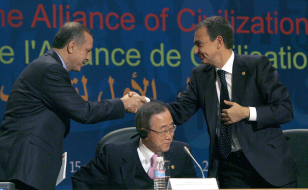



The Alliance of Civilisations, of which Turkish Prime Minister Recep Tayyip Erdoğan is co-sponsor, stands for freedom of expression, peace education, education in the culture of pluralist religion and youth work.
However, Erdoğan’s own government is not following these policies.
Aim of Alliance
The initiative aims at destroying prejudices between Muslim and Western societies by creating collaborative projects between the private sector, governments and international organisations and developing media, education, youth and migration projects. The alliance foresees religious leaders, NGO leaders and politicians working together.
Situation in Turkey
When one looks at Turkey, the government is refusing to abolish obligatory religious education classes, and discriminatory educational practices continue. The UNDP has called on Turkey to develop education, health and employment strategies for its youth. The country is further not taking any steps to resolve problems with the media and the freedom of expression
Formation of Alliance
The alliance was first suggested by Spanish Prime Minister Jose Luis Zapatero at a United Nations assembly in September 2004. In November, a group of states and international organisations began to support the intiative in order to develop intercultural dialogue.
In June 2005, Erdoğan became co-sponsor of the alliance on Turkey’s suggestion. In July, Zapatero and Erdoğan asked the UN General Secretary of the time, Kofi Annan, to announce the alliance to member states and requested that a high-level group of experts meet.
Members of the group were from different countries. Following several meetings, they prepared a report for Annan in 2006.
Report and suggestions
The High Level Group report said that:
- inequalities in the world were on the rise
- terrorist attacks and wars in recent years had strenghtened prejudices, and that theories on “the clash of civilisations” had encouraged such prejudices
- in order to overcome the current situation, communication between people of different cultures and religious beliefs, in particular Muslim and Western societies, had to be strenghtened.
The report argued that
- violence in Israel and Palestine, Iraq and Afghanistan increased the problem. It suggested supporting a two-state solution for Israel and Palestine.
- democratic and pluralist leadership should be supported, particularly in Muslim countries.
- the freedom of belief must be protected.
- poverty must be fought against.
The Alliance of Civilisations has listed its “priority areas” as education, migrants, youth and media. It suggests pluralist religious education, peace education, programs of change, media literacy, a struggle against discrimination, and development of press freedom and the freedom of expression.
In April 2007, the new UN General Secretary Ban Ki-moon appointed former Portuguese President Jorge Sampaio as UN High Representative of the Alliance of Civilisations.
Sampaio prepared an action plan, according to which a voluntary fund will be created, and an environment that allows religious leaders, NGO leaders and politicians to come together will be created.
The first main meeting was in Madrid in January 2008 and the second forum took place in Istanbul on 6 and 7 April. (EÜ/AG)



SOCIAL GENDER EQUALITY
Women and Journalists Hand in Hand against Violence
EUROPEAN COMMISSION AGAINST RACISM AND INTOLERANCE
Discrimination and Racism in Turkey Fuel Concern
Unionists in Northern Cyprus Protest PM Erdoğan
Policeman who Beat Juvenile Claimed Self-Protection
HRANT DINK MURDER
Court fully Protects Istanbul Police