









The Guardian:
Supreme Court Threatens Islamic Party's Government in Turkey




Turkey was thrown into crisis yesterday when the country's supreme court moved to oust the government of Recep Tayyip Erdogan and close down his political party, the country's biggest and most successful.
Case will be heard
The 11-judge court, a bastion of the secularist establishment, decided unanimously to hear a case calling for the closure of Erdogan's ruling Justice and Development party (AKP) as well as banning the prime minister and president from politics for five years on the grounds that they are trying to impose Islamic law in the overwhelmingly Muslim country of 70 million.
The decision followed a failed attempt by the country's military leaders to mount a coup by stealth last year against the prime minister and to stop Abdullah Gul, the former foreign minister, from becoming president and head of state.
"History will not forgive this"
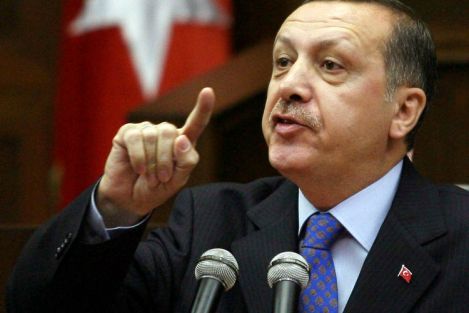
Erdogan, backed by many domestic and international politicians, argues that the court and state prosecution moves are anti-democratic and that his opponents are attempting to overthrow Turkish democracy through the courts because they cannot win at the ballot box.
"History will not forgive this," he said yesterday. "Those who couldn't fight the AKP democratically prefer to fight with anti-democratic methods."
State prosecutors claim Erdogan is seeking to turn Turkey into a theocracy and want to ban 71 politicians, while the prime minister responds that his party is one of Muslim democrats enjoying overwhelming popular support.
Last year Erdogan called the military's bluff when it threatened to bring him down because of his nomination of Gul for president. He ordered early elections, a gamble that resulted in a landslide when his party took 47% of the vote securing the biggest election victory in Turkey in 40 years. He then had Gul installed as head of state.
Osman Paksut, deputy chairman of the supreme court, said all 11 judges had resolved to hear the case following last month's 162-page indictment of the AKP by the country's chief prosecutor, Abdurrahman Yalcinkaya, although four of the judges dissented from including Gul in the case. The AKP has a month to respond to the decision and Erdogan is threatening to change the constitution to make such bans impossible.
EU process undermined
But the power struggle between Ankara's secularist elite and the new class of conservative, reformist Muslims represented by Erdogan and his party is likely to last into next year, undermining Turkey's EU ambitions and discouraging foreign investment.
Brussels came out strongly in support of Erdogan and said the court decision was unjustified. "The prohibition or dissolution of political parties is a far-reaching measure which should be used with the utmost restraint," said Olli Rehn, the EU official dealing with Turkey's bid to join the union. "Such a measure may only be justified in the case of parties which advocate the use of violence or use violence as a political means to overthrow the democratic constitutional order."
Headscarf amendment was last straw for prosecutor
If last year's crisis was ostensibly triggered by Gul's presidential bid, the latest attempt to oust the government was precipitated by the government's move, earlier this year, to open up higher education to women wearing Muslim headscarves.
"The AKP is founded by a group that drew lessons from the closure of earlier Islamic parties and uses democracy to reach its goal, which is installing sharia law in Turkey," said the charge sheet against the AKP. "There is an attempt to expunge the secular principles of the constitution."
Turkey's constitution bans the headscarf in universities in line with the constitution's stipulation that Turkey is a secular republic.
Erdogan changed the constitution to overturn the headscarf ban, arguing that this was a victory for liberty and made the country a more equal place. (IT/AG)
* This article appeared in the Guardian on Tuesday 1 April on p18 of the International section. It was last updated at 00:31 on April 01 2008. Sub-headings were added by bianet.

The Ruling Party Wants A Subservient Judiciary Says The Supreme Court

Constitutional Court Starts AKP Closure Trial

Parties Rebuff Call for Reconciliation
Prosecutor: Ergenekon Not Related to Other Trials
AKP was Silent in DTP Closure Trial

AKP Closure: What Do the People Think?

AKP’s Defense against Closure is Hypocritical
AKP: “Closure Trial will Give Us 70 Percent of the Vote”
Reactions to AKP Closure Request
The Ruling Party Wants A Subservient Judiciary Says The Supreme Court
Constitutional Court Starts AKP Closure Trial
Parties Rebuff Call for Reconciliation
Prosecutor: Ergenekon Not Related to Other Trials
AKP was Silent in DTP Closure Trial
AKP Closure: What Do the People Think?
AKP’s Defense against Closure is Hypocritical