





Upper and Lower Fountains Re-opened
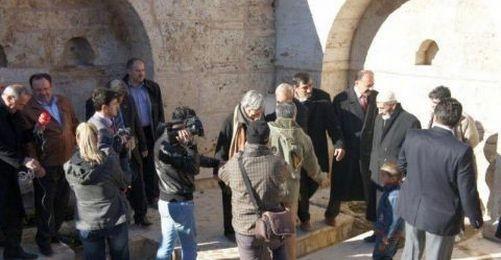



The Habap village (today Ekinözü) saw an opening ceremony that took the attendees back in time to Fethiye Çetin's grandmother Heranus (later on renamed as Seher) who was exiled to the village 95 years ago. The restoration of two historic wells was now finished after a two-year work carried out by the Hrant Dink Foundation.
The restoration project was run on a voluntary basis by architects Nihan Sağman, Mehmet Erkök and Savaş Ekinci and art historian Özge Altınkaya Erkök.
On Friday (25 November), the Lower and Upper Fountains were re-opened in a ceremony attended by the Elazığ Provincial Administration Secretary General, Nazif Bilginoğlu, the Kovancılar District Mayor Bekir Yanılmaz and the Habap village head, Hayati Yarmedelen. The restoration work was supported with monetary sources from the Ministry of Culture, the Chrest Foundation, the Open Society Foundation, General Energy and individual patron of arts.
Lawyer Fethiye Çetin said at the opening ceremony, "My grandmother Heranuş drank water from these fountains a hundred years ago".
Students of the Habap Village Primary School contributed to the ceremony by performing a traditional dance.
The restored fountains feature several springs and arches. Experts see in the wells a classic example of Armenian architecture. The fact that the village of Habap has got two wells suggests that the place was a bigger settlement at the time the fountains were built. Today, the village of Habap/Ekinözü comprises 200 buildings with a population of 1,450 people.
Habap in the old times
Habap or Hebap ('Havav' in Armenian) was a place with 500 buildings in Ottoman times. When the village was inhabited by Armenians it had three churches, a monastery and two fountains. These two fountains were called the Upper and the Lower Fountain.
An inscription on the Upper Fountain in Armenian points to the year 1634.
In recent times, most of the buildings collapsed and the fountains were not functioning any more. The fountains are still registered in the name of the Halil Beyler and Rufekası Beyler Foundation.
The water for the village comes from a very cold spring strong enough to run a mill. It rises two miles off the village in a broad valley.
Since the well is located at a low level it has to be cleaned every spring in order to avoid a reduction of water. The well that was filled with soil in spring was cleaned every year after Easter. The stream was running a few mills and once a week the gardens and fields below the village were irrigated.
The fountains were sacred for the villagers. There were two sweet water springs in the village. One was in the upper and one in the lower part of the village. The water for the fountains came a very long way through underground stone pipes and small cisterns. The cisterns could be reached via a gallery behind the fountains. They needed to be cleaned once a year.
The water of these fountains is cool in summer and lukewarm and sweet in winter. The fountains and the surrounding floor were made out of cut stones. (Dikran S. Papazyan, Badmutyun Palu Havav Kyuği, [Palu Habap Village History] Beirut 1960). (BA/VK)
Click here to visit the photo gallery of the restored fountains of "Grandmother Heranuş".