





KCK TRIAL
Court and Defendants Obstinate on Language Dispute




Defendants of the KCK trial in Diyarbakır insist on presenting their defence in Kurdish just as much as the court determinedly rejects this request.
152 defendants, mainly Kurdish politicians, human rights advocators and members of non-governmental organizations of whom 104 are detained, are being tried for their alleged affiliation to the Democratic Confederation of Kurdistan (KCK)/Turkey Assembly, an organization that intends to organize the Kurdish people and includes the militant Kurdistan Workers Party (PKK).
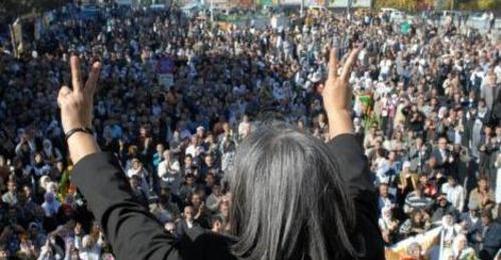
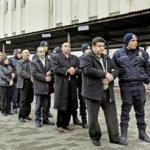
Hundreds of people gathered in front of the courthouse before the hearing on Thursday (11 November). Selahattin Demirtaş, Co-chairman of the Peace and Democracy Party (BDP), said in a brief speech that it was an insult of the Kurdish people to say "You can speak Kurdish at home and in the street but not at court as a public area".
In a demonstration heading to the courthouse, people shouted slogans such as "The PKK is the people and the people are here" or "Pressure does not intimidate us". The demonstration was also attended by BDP deputies and mayors.
"We can listen to anybody talking in Turkish"
The trial started on 18 October and hearings have continued on a daily basis since then. The Thursday hearing was the last session of the first cycle before a new date for the following hearing was announced. The case was postponed to 13 January 2011. Within the first three weeks of the trial, only a summary of the lengthy indictment was read out. The case did not advance to the presentation of the defence yet.
The defendants and their lawyers refer to the Treaty of Lausanne that secures the right to a defence in the mother tongue. The court on the other hand relies on the fact that the defendants know the Turkish language and hence does not acknowledge the need to appoint an interpreter.
98 of the 104 detained defendants attended yesterday's hearing.
The first defendant called to the court podium by Court President Menderes Yılmaz was Kamuran Yüksek, one of the executives of the banned pro-Kurdish Democratic Society Party (DTP). Yüksek said that he was going to deliver his defence in Kurdish. The court president said that the decision on this topic was clear and asked the defendant to return to his place if he would not speak Turkish in his defence.
The defence lawyers reiterated that it was both opposing the law to refuse permission for a defence in Kurdish and a violation of a fair trial. Defence lawyer İbrahim Tali Uysal called on the court to refrain from further "obstinacy".
The court president replied, "If there is anybody who is going to present his defence in Turkish, we are going to listen. We know that some of you do not know the Kurdish language. We allow you some time to think and will continue the hearing in the afternoon".
Some of the detained defendants have been in jail for the past 19 months.
The court dismissed the repeated requests for the defendants' release. With the adjournment of the case to January next year, several defendants will have stayed in prison for two years without conviction by then.
In one of the previous hearings, the court had the Kurdish language defined as an "unknown language" in the minutes. (EÜ/EÖ/VK)


KCK TRIAL
Static Procedures - Dynamic Protest
KCK Trial still Jammed on Defence in Kurdish
DIYARBAKIR KCK TRIAL
Kurdish Speaking Defendants Silenced at Court
The Never-Ending Story of the KCK Indictment
INTERNATIONAL FEDERATION OF HUMAN RIGHTS
Detentions in KCK Trial Violate "Principle of Innocence"
Rejection of Kurdish Defence Provokes Legal Action
KCK TRIAL
Static Procedures - Dynamic Protest
KCK Trial still Jammed on Defence in Kurdish
DIYARBAKIR KCK TRIAL
Kurdish Speaking Defendants Silenced at Court
The Never-Ending Story of the KCK Indictment
INTERNATIONAL FEDERATION OF HUMAN RIGHTS
Detentions in KCK Trial Violate "Principle of Innocence"
Rejection of Kurdish Defence Provokes Legal Action
SOCIAL GENDER EQUALITY
Women and Journalists Hand in Hand against Violence
EUROPEAN COMMISSION AGAINST RACISM AND INTOLERANCE
Discrimination and Racism in Turkey Fuel Concern
Unionists in Northern Cyprus Protest PM Erdoğan
Policeman who Beat Juvenile Claimed Self-Protection
HRANT DINK MURDER
Court fully Protects Istanbul Police