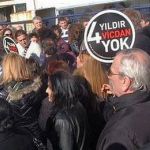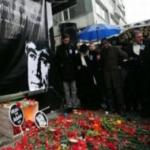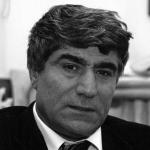
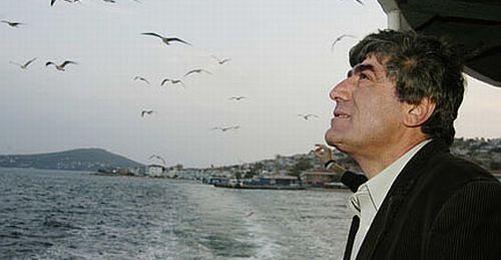



The European Court of Human Rights (ECHR) convicted Turkey of a violation of the right to life, the right to an effective remedy and freedom of expression in the scope of the trial on the murder of Turkish-Armenian journalist Hrant Dink. Dink, then editor-in-chief of the Armenian Agos newspaper, was killed in front of his office on 19 January 2007. The trial at the international court comprised a total of five applications filed to the ECHR by Dink before the assassination and by his family afterwards, which had been merged later on.
The ECHR unanimously decreed for violations of Article 2 of the European Convention on Human Rights on the "right to life", "freedom of expression" enshrined in Article 10 and "the right to an effective remedy" according to Article 13 of the convention.
The ECHR ruled for € 100,000 to be paid to Rakel Dink, the wife of the slain journalist, and his children and a further € 5,000 for Dink's brother Hosrof Dink in compensation. Turkey has to pay another € 28,595 for cost and expenses. Thus, Turkey is going to pay a total fine of € 133,595.
ECHR: Responsibility of taking precautions was clearly violated
The ECHR indicated that the Trabzon Governorship had not issued permission for the prosecution of more than two gendarmerie officers:
"A judicial decision was not reached regarding the question why the higher-grade officials, who held the authority of preventing the murder, remained passive even though the non-commissioned officers had forwarded relevant information. This shows obvious negligence of the responsibility to take precautions when evidence of the incident had been provided".
The ECHR emphasized that the governorship's decision against an investigation of the police officers conflicted with other facts included in the file: "The prosecution was convinced that the police did not take the warnings about assassination plans seriously. Nevertheless, the same police warned the Istanbul Police about the immediate danger of the assassination".
"Prosecution did not investigate, the concern was to protect the police"
The Strasbourg-based court pointed out that the Trabzon Governorship decided not to launch a probe despite the investigation of the Chief of Police. "The investigation launched by the prosecution remained limited in order to protect the police. It did not reveal any further evidence for the passiveness regarding the murder suspects".
The ECHR dismissed the Turkish government's defence that "the court decision against Dink had not been finalized by the time of the murder". The court referred to the approval of the decision by the Court of Appeals General Criminal Board and added, "Moreover, this decision made Hrant Dink a target for extremist nationalists. The officials did nothing to protect him". The journalist had been convicted of "insulting Turkishness" in a case decided prior to his death.
Turkey did not fulfil "positive responsibility"
After studying the matter of "Turkishness", the European court concluded that the Court of Appeals had punished Dink for his criticism of state institutions for not recognizing the events in 1915 as genocide.
The ECHR underlined that all member states had the responsibility to create an environment where individuals can participate in social discussions. It was declared that Turkey did not meet the necessity of a "positive responsibility" such as the protection of freedom of speech to prevent future attacks on individuals.
Turkey's defence submitted to the court was criticized because of the "Nazi reference" and the point that Dink "did not ask for protection".
No appeal
The Ministry of Foreign Affairs announced not to file an appeal against the decision. "All possible precautions will be taken to avoid the repletion of similar violations", the ministry declared. (EÖ/VK)