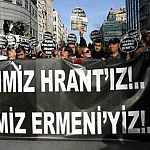



More than three years after the assassination of Turkish-Armenian journalist Hrant Dink, the Turkish government submitted their defence to the European Court of Human Rights (ECHR) related to the conviction of Dink because of "insulting Turkishness". The government accused Dink of "inciting the public to hatred" and claimed the journalist's article on subject to constitute a "hate speech".
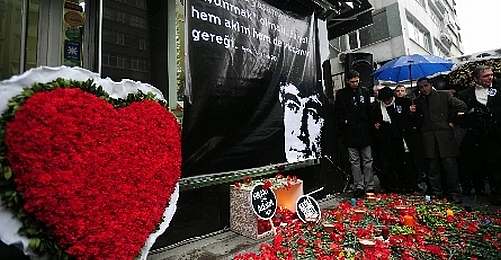
Dink, founder of the Armenian Agos newspaper, was prosecuted on the grounds of one sentence in an article about the Armenian identity and the recognition of the events in 1915 as genocide. The journalist, then editor-in-chief of the Armenian weekly, had been shown as a target in course of the trial. He was convicted under article 301 of the Turkish Criminal Code (TCK) and after that he got killed in front of his office in Istanbul on 19 January 2007.
Dink had applied to the ECHR upon his conviction. After his assassination, Dink's family had furthermore applied to court due to alleged negligence of official authorities to prevent the murder. The ECHR merged both applications.
The person who threatened the newspaper was punished anyways...
According to the Turkish nation-wide Radikal daily, the government stated in their defence that the penalty for Dink had not been finalized yet by the time the journalist applied and thus he actually did not have the right to apply. Yet, the sentence handed down to Dink had been approved by the Court of Appeals Penalty Council.
In order to prove the legitimacy of Dink's sentence, the government referred to the Kühnen case previously tried before the international court. The ECHR had approved the decision by German courts to punish Kühnen, a neo-Nazi who had spread anti-Semitic hate speeches in various pamphlets.
The government was interrogated regarding the fact that public officials failed to prevent the murder even though they knew about an assassination plan prior to Dink's murder. "Dink would have applied to the local authorities and would have asked for protection if he had really been under an immediate threat", the government claimed.
Additionally, the government emphasized that a person who had sent threats to the Agos newspaper when Dink was the chief editor had been convicted. "If it is agreed that the protection of freedom of thought is a positive responsibility of the state, then the ideas expressed on a disputable matter as in the letters sent by this person should also be agreed on as discussable and these thoughts must be protected as well", the government stated.
Foreign Ministry: Unacceptable Criticism
Subsequent to the news in Radikal, the Ministry of Foreign Affairs said in a written statement,
"It is out of the question to justify in any way the assassination of Hrant Dink, one of the extraordinary precious intellectuals of our country. Regardless of the legal processes involved, it is entirely unacceptable to even imply that the government takes any efforts to legitimize or justify this murder. The views of the government directed towards the ECHR were solely prepared under legal and technical aspects. It is both wrong and unjust to intentionally render political results in the context of the Hrant Dink murder based on this defence".
The Minister of Justice, Sadullah Ergin, also said that the issue 'could not be linked to a Nazi example' and that it was a "liberal interpretation" of the amended article 301. (EÜ/VK)