KURDISH QUESTION
98 NGOs Call for End of Violence - PKK Refuse Unilateral Ceasefire
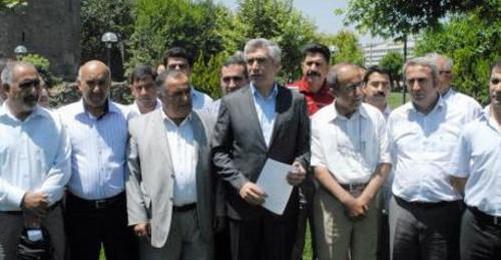



98 organizations from Diyarbakır in the pre-dominantly Kurdish region of south-eastern Turkey issued a joint statement to call for creating an environment where weapons remain silent.
The statement signed by the bar association, non-governmental organizations, professional organizations, rights organizations and trade unions was read out on Monday (28 June) by Galip Ensarioğlu, President of the Diyarbakır Chamber for Trade and Industry (DTSO). Confronting claims that the statement had been changed upon pressure imposed by the outlawed Kurdistan Workers Party (PKK), Sarıoğlu clarified, "We did not receive any threats. In fact, we do not accept such a threat from anybody even it would have been imposed on us".
The paper was prepared by the Civil Servant Unions Confederation (Memur-Sen) after three days of interviews and discussions.
Ensarioğlu stated, "In our opinion, MHP [National Movement Party] and BDP [pro-Kurdish Peace and Democracy Party] should also play an active role in the solution. We do not want to name anybody in particular. We want everybody to be involved".
Criticizing the government
The statement emphasized that the opportunity for a solution that had emerged during the past year was wasted. In summary, the paper criticized the lack of a democratizing legislation, the remaining obstacles for freedom of expression and the lack of reforms of the Law on Elections and Political Parties.
Furthermore, the organizations claimed that the government's constitutional reform package did not serve democratization. It was also said that the detention of members of the "peace groups" that came from Mahmur and Qandil in October 2009 paved the way to violence.
Freedom of expression, constitution, Habur...
The organizations pointed out the following issues:
* Democratic laws that would convey a sense of trust to the Turkish society were not implemented in time.
* Obstacles before freedom of thought, freedom of expression and freedom of association were not removed although they prevented free discussions of the Kurdish questions in all its dimensions.
* The election system was not reorganized.
* The constitution draft did not facilitate a solution of the Kurdish question.
* It could be observed that the detention of members of the peace groups, of children, elected politicians and human rights defenders paved the way to violence and the use of weapons.
PKK: no unilateral ceasefire
The Peoples' Confederation of Kurdistan (KCK) as the umbrella organization for the militant PKK announced that the call for a unilateral ceasefire is currently "not meaningful".
As reported by the Fırat News Agency, KCK executives declared on Sunday (27 June), "It is not us who needs to fulfil the requirements for a ceasefire, but the state and the government. It is the Turkish State and the AKP [ruling Justice and Development Party] governments that need to be persuaded and called upon. [...] Calling the PKK for a unilateral ceasefire means a recommendation to surrender to a relentless dominant power. Such an attempt should not be made in a peaceful environment advocating for human rights".
The KCK pointed out that the conflicts would not come to an end unless "concrete steps that increase trust" were taken.
The PKK cancelled the decision for a ceasefire on 1 June. About 40 soldiers died during the past two months in conflicts with the PKK and of land mine explosions. Besides the south-east of the country, bomb attacks were carried out in Istanbul and Iskenderun (eastern Mediterranean coast). At the same time, military operations increased.
The government states to "lead the struggle against terror with determination". Last week, also organizations such as the Association of Turkish Industrialists and Businessmen and the Turkish Union of Commodity Exchange Chambers called for taking the weapons down. (TK/EÜ/VK)
Click here to see a list of the Diyarbakır organizations that signed the joint statement.


Protest Attacks in Bingöl and Yüksekova

Öcalan Announces Suggestions for Peace
"A Solution for the Kurdish Question must be a Solution for Turkey"
Unrest against Kurdish Population in Hatay
505 Lawyers Call for End of Military Operations
Wave of Violence in South-Eastern Turkey Does not Abate
Öcalan Calls for Democratic Peace to Extend Ceasefire
TAK Claims the Responsibility for the Bomb Attack
11 Soldiers Died in PKK Attack

KURDISH QUESTION
Call from Diyarbakir: Ceasefire an Opportunity for Dialogue
Protest Attacks in Bingöl and Yüksekova
Öcalan Announces Suggestions for Peace
"A Solution for the Kurdish Question must be a Solution for Turkey"
Unrest against Kurdish Population in Hatay
505 Lawyers Call for End of Military Operations
Wave of Violence in South-Eastern Turkey Does not Abate
Öcalan Calls for Democratic Peace to Extend Ceasefire
TAK Claims the Responsibility for the Bomb Attack
11 Soldiers Died in PKK Attack
KURDISH QUESTION
Call from Diyarbakir: Ceasefire an Opportunity for Dialogue
SOCIAL GENDER EQUALITY
Women and Journalists Hand in Hand against Violence
EUROPEAN COMMISSION AGAINST RACISM AND INTOLERANCE
Discrimination and Racism in Turkey Fuel Concern
Unionists in Northern Cyprus Protest PM Erdoğan
Policeman who Beat Juvenile Claimed Self-Protection
HRANT DINK MURDER
Court fully Protects Istanbul Police