Eroğlu New President of Northern Cyprus
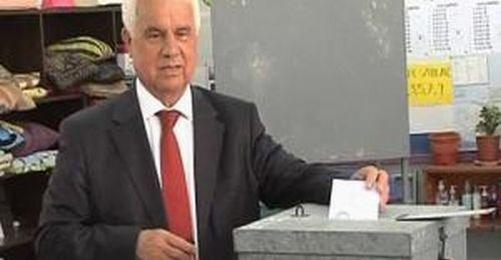



Prime Minister Derviş Eroğlu, candidate of the National Unity Party (UBP), won the presidential elections in Northern Cyprus on Sunday (18 April) in a clear victory. Eroğlu had run for elections four times before and came out as the winner for the first time. He is the third president of Northern Cyprus after Rauf Denktaş and Mehmet Ali Talat.
According to Nevvar Nolan, Supreme Election Board Chairman of Northern Cyprus, Eroğlu got 50.37 percent of the votes; independent candidate Mehmet Ali Talat received 42.84 percent.
First statement: Negotiations will continue
In his first statement after the announcement of the election results, Eroğlu said, "I thank the people for their loyalty. This reflects the political will of our people despite all other things. Negotiations will continue. I gained the people's appreciation. It is an important matter that I came out of these elections as the winner".
In his statement made at the UBP Headquarters, Eroğlu said he was determined to continue talks with Dimitris Christofias, President of Greek Cyprus in the south of the island, "I think that we can reach a deal with Christofias within a certain time frame".
Eroğlu had briefly talked to United Nations (UN) Secretary General Ban Ki-Moon during his visit to Northern Cyprus, saying that he would 'reach a deal with Christofias and Ban once Mr. Talat would beat retreat'.
Southern Cyprus: Negative development
The government of Southern Cyprus assessed the election outcome as a "negative development". Government spokesman Stafanos Stefanu commented, "What is important now is to get to the fundamentals of this development, how we will handle matters, so that we are able to implement the aims of a solution".
New phase of negotiations
Former president of Northern Cyprus Talat had said to provide a solution within one to one and a half years. Eroğlu blamed Talat of making too many concessions. The new president claimed he would not continue the talks where Talat had left them, but that he would re-open all topics to negotiation again.
Eroğlu opposed the idea of a "federation based on two constituent states" as it was put forward by Talat and Christofias. Eroğlu promotes the concept of two equally independent states on the island instead of the loose federation of two zones with a central administration as previously suggested by Talat and Christofias.
75 percent election turnout
According to Supreme Election Board Chairman Nolan, the election turnout as shown at 5.45 am on Sunday amounted to 73 percent in the capital of Nicosia, 78 percent in Gazimağusa, 74.5 percent in Girne, 72 percent in Güzelyurt and 76percent in İskele.
Third president of Northern Cyprus
The presidential election on Sunday was the eighth election in the Turkish part of Northern Cyprus since 1976. Seven independent candidates ran campaigns in a total of six elections.
In the elections in 2005 with an election turnout of 69.58 percent, Talat was voted for president in the first go with a total of 55.59 percent. Eroğlu had won 22.73 percent of the votes in the same election. (BB/VK)


JOURNALIST TAYFUN ÇAĞRA COMMENTS
"Erdoğan Will Demonstrate his Strength!"
UN: "Cyprus Negotiations Picked up Momentum again"
CYPRUS NEGOTIATIONS
UN Secretary-General Ban Ki-moon Visited Cyprus
35 Years After "Peace Operation" Still No Solution For Cyprus
Government Change in Northern Cyprus
JOURNALIST TAYFUN ÇAĞRA COMMENTS
"Erdoğan Will Demonstrate his Strength!"
UN: "Cyprus Negotiations Picked up Momentum again"
CYPRUS NEGOTIATIONS
UN Secretary-General Ban Ki-moon Visited Cyprus
35 Years After "Peace Operation" Still No Solution For Cyprus
Government Change in Northern Cyprus