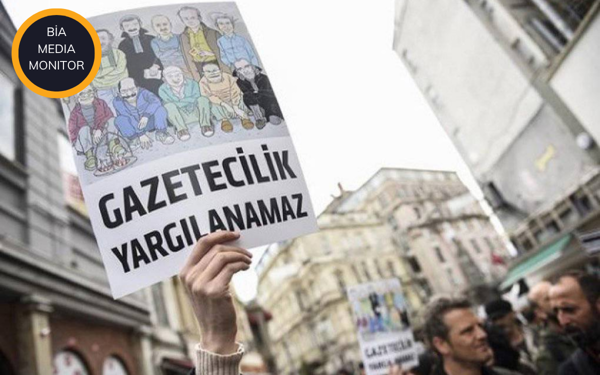
Minority Report Case Goes To Justice Ministry To Obtain Permission For Trial Under Article 301




The 28th Criminal Court of First Instance of Ankara sent the article 301 case file for Prof. Dr. İbrahim Kaboğlu, former head of the Human Rights Advisory Board of the Prime Ministry (BIHDK), and Prof. Dr. Baskın Oran, head of the subcommittee of the same board, to the to the Ministry of Justice to obtain permission for their prosecution. under article 301. The lawsuit was filed for "inciting hatred and hostility" by using the term "Türkiyelilik" (to be from Turkey) instead of Turks in the Minority Rights and Cultural Rights Report prepared by these academicians.
Judge Avni Mis rejected the demand by the accused and their lawyer Oya Aydın to send article 301 to the Constitutional Court.
The four year old file is at the ministry, the next hearing in April
By sending the case file to the ministry to obtain the necessary permission to continue the trial, Judge Mis postponed the trial to April 1, 2009.
Suspect’s lawyer Aydın demanded in today’s hearing that the article should have been sent to the Constitutional Court for restricting the freedom of expression.
She argued that the said article is against the sixth article of the European Convention on Human Rights about “fair trial”, which emphasizes the concepts of the rule of law and the independence of the judiciary.
“The Ministry of Justice is a political post. When it will make its decision, either for or against us, we will still be in the position of not having talked about our problem. Sending the case file to the ministry after four years points to a problem in the legal process. Having a political post decide whether or not one is guilty of a crime without a mechanism to control its decision may lead to arbitrariness. Since this procedure calls for an intervention by the executive branch, it is unconstitutional.”
“The second problem is that article 301 violates the freedom of expression. On the one hand, the denigration clause is not clear, on the other hand, it also states that the act of criticizing cannot be punished. Respect to the state cannot be maintained this way.”
Article 301 has created crisis in Turkey
Stating that this article lead Turkey into a crisis, Kaboğlu and Oran said the condition of permission is like asking for the forgiveness of the ministry.”
Moreover, Oran added that this crisis can be turned into an opportunity by sending this file to the Constitutional Court. The court said they might consider this demand after the file comes back from the ministry.
On May 10, 2006, Ankara's 28th Criminal Court had dropped the Article 301 charge, following the reply by the Justice Ministry that the conditions for the trial for the charge of “denigrating Turkishness” had not been established, and had ruled for the acquittal of the defendants of the Article 216 charge, “inciting hatred and hostility among people.”
The Supreme Court of Appeals 8th Penal Circuit had later overturned the acquittal decision regarding the Article 216 charge, ruling that the corporeal and incorporeal conditions of the crime had existed. (EÖ/TK)


A graduate of the French Language and Literature Department at İstanbul University. He has served as the Turkey representative for the international organization Reporters Without Borders (RSF), where he began as a reporter in 1996. Since 1999, he has worked at bianet, a project of the IPS Communication Foundation, as the coordinator of the Legal Support Desk, editor for freedom of expression, and editor-in-chief. He has authored more than 4,800 signed news articles and opinion pieces. He has also written for Bizim Gazete and the journal Güncel Hukuk. He currently prepares the Media Monitoring Reports at bianet.




MAY 3 WORLD PRESS FREEDOM DAY
Journalism rights thrive on reader support!
BİA MEDIA MONITORING REPORT 2025
Those who want to silence journalists are now more brazen!
BİA MEDIA MONITORING OCTOBER-NOVEMBER-DECEMBER 2025
The future of journalism is in danger under government pressure!
BİA MEDIA MONITORING JULY-AUGUST-SEPTEMBER 2025
Prolonged detentions and judicial control tighten pressure on journalists
BİA MEDIA MONITORING APRIL-MAY-JUNE 2025
Unprecedented pressure on journalists under the government's watch