CONSTITUTIONAL REFORM PACKAGE
Political Propaganda in Kurdish and Children's Rights

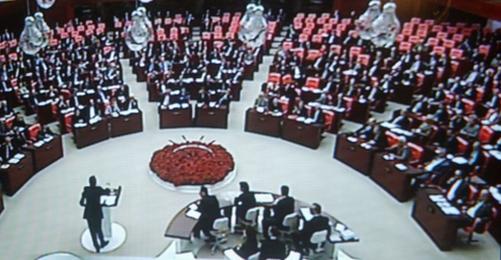



The Parliamentary Constitutional Commission, discussing amendments for the elections law, accepted an amendment regarding oral political propaganda in the run-up for elections to be made in languages other than Turkish.
Once the amendment will have been enforced, political parties and candidates may make propaganda during elections campaigns in regional languages and dialects traditionally used in daily life in Turkey. This will "not be contrary to the constitutional state and to the indivisible integrity of the nation as basic properties of the republic's Constitution". Nevertheless, "in propaganda published on radio or television and other election propaganda, the use of the Turkish language is compulsory".
Decrease of election threshold declined
Peace and Democracy Party (BDP) MP Hamit Geylani had proposed to decrease the election threshold from then to three percent. MPs from the Republican People's Party (CHP) and the Nationalist Movement Party (MHP) abstained from voting while the ruling Justice and Development Party (AKP) voted against the proposal. AKP MP Burhan Kuzu remarked that on an international scale the election threshold amounts to three to five percent, figures that according to Kuzu would cause permanent coalition governments in Turkey.
Prosecution of Children
The draft bill of the constitutional reform package currently discussed in the parliament furthermore envisages an amendment of article 250 on "defining the outlines of duty and judiciary" of the Criminal Procedural Law (CMK). The draft bill was amended in respect to prosecution of children at juvenile courts to be made compulsory regardless of the kind of crime they allegedly committed. This would protect children from prosecution at high criminal courts.
Court may postpone prosecution of children
Regarding article 17 of the Children's Protection Law, investigations and prosecution related to a criminal offence committed together with an adult shall be carried out separately.
According to the article, if deemed necessary, the court may wait for the result of the trial at the ordinary court before starting the prosecution of the child.
In case it is considered necessary to try the cases at the same time, the ordinary court can decide to merge the trials at any stage of the prosecution. In that case, the trial will be held at an ordinary court.
Current regulation opposes children's rights
In the course of amendments made in 2006, children aged 15-18 are currently tried in the scope of the Anti-Terror Act (TMK) at special authority courts instead of juvenile courts. Additionally, the implementation of the judgement cannot be suspended. This regulation is contrary to the United Nations Convention on Children's Rights, principles of justice for children and national legislations such as the Children's Protection Law.
In places lacking juvenile courts, children shall be prosecuted at regional courts or high criminal courts. Children's rights defenders criticise that this regulation is not sufficient to protect children from becoming victims. (TK/BB/VK)


CONSTITUTIONAL REFORM PACKAGE
Five Amendments Passed - Children's Rights Dismissed
CONSTITUTIONAL REFORM PACKAGE
Constitutional Amendment for Protection of Children from all Kinds of Abuse

Draft Bill Does not Prevent Injustice for Children on Trial!
CHILDREN'S RIGHTS
Adana: 3,155 Children Arrested in 2009
UNICEF Report about Children Accused for "Terror Crimes"

KURDISH INITIATIVE AND THE RIGHT TO KURDISH POLITICS
Prison Sentence for "Propaganda in Kurdish"
ECHR Will Tackle Ban On Propaganda in Kurdish

CONSTITUTIONAL REFORM PACKAGE
Five Amendments Passed - Children's Rights Dismissed
CONSTITUTIONAL REFORM PACKAGE
Constitutional Amendment for Protection of Children from all Kinds of Abuse
Draft Bill Does not Prevent Injustice for Children on Trial!
CHILDREN'S RIGHTS
Adana: 3,155 Children Arrested in 2009
UNICEF Report about Children Accused for "Terror Crimes"
KURDISH INITIATIVE AND THE RIGHT TO KURDISH POLITICS
Prison Sentence for "Propaganda in Kurdish"
ECHR Will Tackle Ban On Propaganda in Kurdish