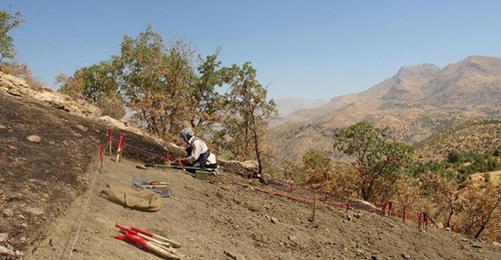



Muteber Öğreten from the Initiative for a Mine-Free Turkey indicated that every 3 days people are killed or wounded by landmines. According to Öğreten, this figure has not changed since the Ottawa Treaty was ratified by Turkey in 2003.
The Initiative for a Mine-Free Turkey and the International Landmine Ban Campaign published their report for 2009 in a press conference on 12 November. Apart from Öğreten, Hüseyin Demirdizen from the Turkish Medical Association (TTB), Erol Kızılelma from the Social Democracy Foundation (SODEV) and Ergün İşeri from the Disabled People Association commented on the current situation in the press conference.
Öğreten emphasized that Turkey is not fulfilling the requirements of the treaty. He evaluated the country's position as follows:
Öğreten: The purpose of the treaty is to eliminate losses and suffering caused by anti-personal landmines. The law regarding landmine clearing on the Syrian-Turkish border enforced in 2008 is not part of the treaty's conditions. The conditions defined by the Ottawa Treaty are not fulfilled just by landmine clearance, if at the same time physical and psychological support is not granted to the victims and personal damage is not being eliminated.
Öğreten continued that in order to reduce the number of mine victims measurements can be taken in the regions as risks. Local residents could receive corresponding education and children in primary school could have compulsory lessons on this topic.
Kızılelma: The public has to be mobilized as an element of pressure for the landmine clearance. Necessary measures for clearing the landmines are not being taken. It is important to open the cleared areas to public use, this is what is required in a democracy.
Demirdizen: The law issued in 2008 revealed that the government is looking at the matter from a perspective of annuities. In the context of mine clearance there are several goals on the agenda, the problems of the victims must be our priority. There are unavoidable health problems as well as health problems caused by the mines that could be prevented. Landmines have been created by humans and humans can stop them. At this point, the government has to take action urgently.
İşeri: The problems of the landmine victims can be summarized like this:
- They have problems to find a job. Their only income is a government allowance of 180-200 Turkish Lira (about € 80-90). Families of mine victims are supposed to live on that amount.
- Infrastructure is insufficient. Many victims of dismemberment do not even have a prosthesis.
- Limited education opportunities.
- Lack of required rehabilitation activities. No action for reintegration into the society.
- No research has been made on the number of victims in mined regions after evacuating villages. The migrants cannot return to these areas because of anti personal mines.
After the clearance of mined land the victims have to be considered. By opening the cleared areas to the public, economic and social opportunities must be created for the landmine victims. (EY/TK/VK)