Chief of Staff’s Speech Did Not Impress Kurdish Politician
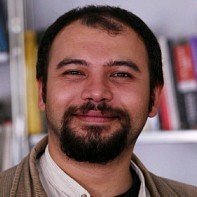



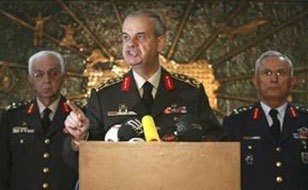
Ekinci, a member of the Turkish Peace Parliament, said that the speech showed a change in the use of certain expressions, but that there was no change in its essence, that the speech contained neither democracy nor scientific elements.
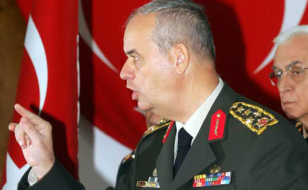
He argues that the speech represented “a forced change in expression due to general political developments.”
Some of the mainstream media has interpreted the speech as progressive. For Ekinci, the only progress was that Başbuğ used the word “Kurd”. “For the first time, a Chief of Staff has expressed the existence of Kurds as a society with a sub-identity. That is important.”
However, on other aspects of the speech, Ekinci was pessimistic.
He should not be speaking: In democracies, the army and the Chief of Staff are under civilian control. They can share their opinions with the civilian authorities, but I cannot reconcile a Chief of Staff expressing his opinion like a political party leader, in public, with democracy. There has never been a Chief of Staff in Turkey who has departed from this tradition.
Insistence on “the Turkish nation”: The words that Mustafa Kemal Atatürk used 80 years ago are being repeated. In addition, Başbuğ’s use of “the people (singular) of Turkey” is incomplete. People who acknowledge the existence of other peoples in the country use the expression “the peoples of Turkey”. People have been convicted for the latter expression, me too. Furthermore, Başbuğ is still insisting that “Turkish” refers not to an ethnicity but to the name of all the citizens of Turkey. But in reality, the word “Turkish” has been used in a racist manner in laws, practices and court decrees.
Denial of assimilation: It is wrong of him to say that “there has been no assimilation.” Tens of thousands of people have been assimilated. It has not been possible for a people under severe pressure to have its voice heard. As Kurdish society experienced class change and the number of intellectuals increased, democratic demands were voiced.
Amnesty is up to political government: What Başbuğ said about getting PKK militants down from the mountains shows that he does not support a serious amnesty law. It is up to the political government to decide whether there will be an amnesty, amendments of laws or other practices. Perhaps the government will announce a general amnesty; Başbuğ has no right to obstruct this. I believe that an amnesty is possible and necessary.
Top-down laicism: When Başbuğ talked about laicism, he did not discuss the freedom of people to organise according to their own beliefs, and he did not discuss the fact that religious organisation is being carried out by the state. He is supporting the current structure of a statist, centralised, top-down laicism.
Protecting the autonomy of the army: Başbuğ said that the armed forces were under civilian authority, but he added that “each country has its particular conditions.” That is very meaningful and he used it to say that the army would not be under civilian authority absolutely. This was a speech protecting the lack of transparency in the army and its autonomous structure. The media talked about a “democratic and progressive speech” in its headlines, but I disagree.
EU: Başbuğ did not talk about EU membership, although it is important for the acceptance of the Copenhague criteria and democratisation. Any steps towards democratisation in recent times have been taken because of the EU. (TK/AGÜ)

Turkish Armed Forces Don’t Let All Media Watch
"Kurdish Issue Is Bigger Than Disarming the PKK"

PKK Expresses Hope for Peace

Chief Of Staff Attacks The Media
New Chief Of Staff Insists On Not Recognizing The Kurdish Identity

İlker Başbuğ Is The New Head Of The Turkish General Staff

Başbuğ Says His Meeting Has Nothing To Do With Ergenekon

Turkish Armed Forces Don’t Let All Media Watch
"Kurdish Issue Is Bigger Than Disarming the PKK"
PKK Expresses Hope for Peace
Chief Of Staff Attacks The Media
New Chief Of Staff Insists On Not Recognizing The Kurdish Identity
İlker Başbuğ Is The New Head Of The Turkish General Staff
Başbuğ Says His Meeting Has Nothing To Do With Ergenekon
KURDISH QUESTION
PKK Ceasefire to be Terminated on 31 October?
KCK CASE
Court Dismissed Request for Defence in Kurdish
7th Istanbul Gathering for Freedom of Thought
CONSTITUTIONAL AMENDMENTS
58 Percent Said "Yes" to Constitutional Reform Package
Rights Organizations 3 Years ahead of Foreign Minister