





FREEDOM EXPRESS
Anti-Terrorism Law Obstructs Freedom of Expression

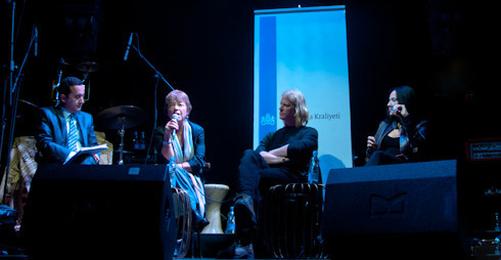



The opening session of the "Freedom Express - Özgürlük Ekspresi", the kick-off meeting of a series of panel discussions, took place at the Ghetto night club in Istanbul Wednesday (16 November). The Freedom Express aims at creating a forum of free thought for the discussion of different ideas without polarization. The event was organized by the Royal Netherlands Embassy and the Consulate General of the Kingdom of the Netherlands.
The first guests of the Freedom Express were journalist Nadire Mater, journalist and photographer Wilco van Herpen and journalist Faruk Mercan. They discussed areas in which freedom of expression is problematic in Turkey. The event was hosted by television journalist Banu Güven.
"Press Freedom occupies a large part within freedom of expression", Güven emphasized and claimed that this situation had an impact on the journalists' freedom to make news as well as on the readers' freedom to information.
"It used to be Article 301, now it is the Anti-Terrorism Law"
Journalist Mater started the discussion by reminding the fact that 71 journalists were in jail in Turkey as of 15 November, the Day of the Imprisoned Writer.
"In the past, Article 301 of the Turkish Criminal Law ["insults" to the Turkish state] was the main stumbling block for people who attempted to use freedom of expression; nowadays it is the Anti Terrorism Law", Mater remarked.
She also mentioned auto-censorship and journalists being prosecuted in the context of trials related to the Union of Kurdistan Communities (KCK), the clandestine Ergenekon organization and other cases involving illegal organizations.
"In the new media order, the press is being directed by big media groups. The media is being shaped according to these groups' links to the global capital and according to their relations to the government. In Turkey, the prime minister calls the media bosses and publication directors to tell them how to make news. Therefore, their employees cannot be expected to defend women rights or to oppose war", Mater claimed. She also stressed that one of the biggest problems for journalists was the lack of organization.
"Why does the government behave like a child?"
Dutch journalist Van Herpen who has been living in Turkey for twelve years said that he came to Turkey when journalist Metin Götepe was killed in police custody. He described how he held out at the gates of the State Security Court for years in order to support the journalists.
"As journalists, we became frightened and without being aware of it we are applying auto-censorship. The toes of the Prime Minister are so long that we might step on his feet with the slightest movement" Van Herpen said and asked, "Why do the state in Turkey and the government behave like a child?"
Van Herpen indicated that freedom of expression should be looked at like a pyramid. He pointed out that freedom of expression started within the family and that the situation of freedom of expression on the level of the ordinary people had to be considered.
Journalist Mercan stated that the situation in Turkey was not that bad. "Listening to what you say I feel as if I was in China. Journalists should not be immune but they should be tried without detention", Mercan voiced his opinion.
Evaluating the arrests of academics like the recent one of Prof Büşra Ersanlı, Mercan said, "Even though I do not consider the political academy of the Peace and Democracy Party (BDP) as a normal academy just as those of other parties, I do not find Ersanlı's arrest right".
The Freedom Express was rounded up with a concert of Baba Zula. (ÇT/VK)


Université Marc Bloch’da sosyoloji bölümünden mezun oldu. 2009’dan 2011’e kadar AFP’de fixer ve çevirmen olarak çalıştı. Gazeteci Burcu Karakaş ile Açık Radyo’da Cadı Postası programını yaptı. 2015 Müşerref Hekimoğlu Başarı Ödülü'nü aldı. 2011-2018 arasında bianet’te kadın ve LGBTİ haberleri editörü olarak çalıştı.

FREEDOM OF THOUGHT AND EXPRESSION FROM 12 TO 12
Joint Struggle for Release of Journalists Must be Continued
HUMAN RIGHTS WATCH
Turkey: Draft Reform Bill Falls Short

FREEDOM OF EXPRESSION
BİA Media Monitoring Report 2011 - Third Quarter Full Text
THOMAS HAMMARBERG
Limited Media Freedom in Europe

DAY OF THE IMPRISONED WRITER
71 Journalists in Jail
Laws Designed to Try Dissidents and Journalists?

FREEDOM OF THOUGHT AND EXPRESSION FROM 12 TO 12
Joint Struggle for Release of Journalists Must be Continued
HUMAN RIGHTS WATCH
Turkey: Draft Reform Bill Falls Short
FREEDOM OF EXPRESSION
BİA Media Monitoring Report 2011 - Third Quarter Full Text
THOMAS HAMMARBERG
Limited Media Freedom in Europe
DAY OF THE IMPRISONED WRITER
71 Journalists in Jail
Laws Designed to Try Dissidents and Journalists?
.jpg)