





Statement by Chief Of Staff
"Detained Generals Innocent until Proven Guilty" Says Gen. Başbuğ
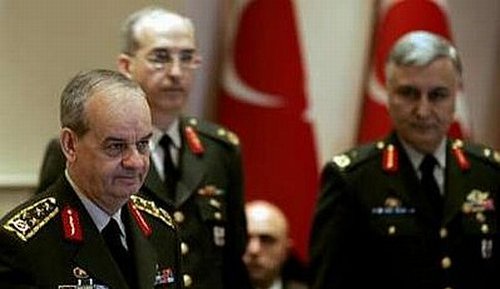



At a press briefing yesterday (29 April), Chief of Staff General İlker Başbuğ answered questions about the Ergenekon investigation and trial.
The investigation into this clandestine ultranationalist organisation has brought to light coup plans by high-ranking army members as well as civilians, and connections between the Ergenekon organisation and many unsolved murders have been stipulated.
Başbuğ declined to say the name of the organisation, saying that the court case should be remembered by its file number. He objected to the journalists’ use of the “Ergenekon Terrorist Organisation”, but was reminded that this term has been used in the prosecution’s indictment.
Some of the issues he talked about are summarised in the following:
“We support democracy, and we have complete trust in the law”: Başbuğ said that the army was faithful to democracy, and that constitutional law and the independence of the judiciary were vital.
Questioning of General Özkök: After it emerged that an Ergenekon investigation prosecutor asked former Chief of General Staff Hilmi Özkök for a statement, Başbuğ said, “It is understood that the Istanbul Chief Public Prosecution has felt the need to apply for Hilmi Özkök’s statement as a witness. What results this will lead to I cannot guess or comment on. The honourable Özkök is also my commander. They only demanded information in terms of legal consultation from us. It is normal for judicial consultants to give advice, and we fulfilled that duty.”
Coup diaries: Referring to the diaries allegedly belonging to retired Admiral Özden Örnek, published in the Nokta magazine, which describe plans for two military coups, Başbuğ said that his predecessor, Yaşar Büyükanıt had been asked about the diaries in 2007, and that the General Staff had no documents relating to that issue. He added that Örnek had denied that the diaries belonged to him.
“Support” for Ergenekon investigation: Başbuğ criticised reports that the Turkish Armed Forces “are supporting the investigation”. “There is nothing as shameful as thinking that any institution can offer or refuse support to a judicial process in a state ruled by law.”
Transfers of defendants to military hospitals: High-ranking military officers who were being tried in detention were transferred to a military hospital. It has been alleged by some that the state of health of some officers was exaggerated in order to avoid detention, and that doctors at the military hospital were collaborating in this deception. Başbuğ commented that he was very disturbed by these accusations. He argued that the Ministry of Justice and not the military monitored the transfers and denied the allegations as “lies and “immorality”.
Soldiers on trial: “Some issues concern retired and active personnel on a personal basis. Everyone is innocent until convicted.” Başbuğ accused the media of convicting people and violating personal rights before the courts have come to a decision and called for responsible reporting.
Criticism of media: Başbuğ criticised the frequent and continuous coverage of the recent excavation of weapons in Poyrazköy, Istanbul on TV channels and reports of an informant in a newspaper “for five days”. He argued that the media had a right to reporting, but that the manner of reporting was damaging institutions. He further condemned revelations of recordings: “We have come to the point where we don’t know any morning whose voice recordings we will be confronted with. Were the voice recordings obtained legally? No. Are they real? No. Maybe some of them. Where are we going with this? This is disturbing us very much.”
Secret witnesses and informants: “We look at the indictments. There are topics there…let me give an example related to the Turkish Armed Forces. In the second indictment there is a statement by a secret witness regarding the event of 1993 in Bingöş [when 33 soldiers were killed in an ambush]. Who is this witness, how trustworthy are they?”
“When we look at the indictments, we see that some accusations are based on statements by secret witnesses and informants. Of course we have not been able to examine all the additional files. But especially the fact that some accusations are based on statements by secret witnesses and informants makes one think.”