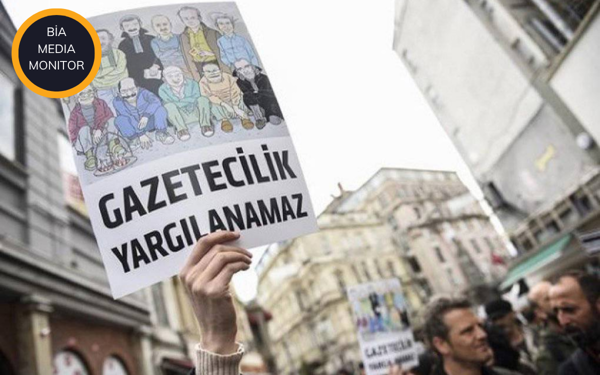
FREEDOM FOR JOURNALISTS CONGRESS
International Call for Freedom for Arrested Turkish Journalists
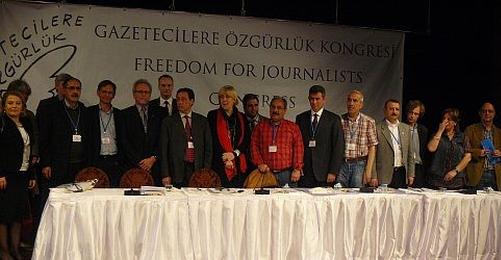



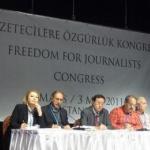
Representatives of the European Federation of Journalists (EFJ), the Association of European Journalists (AEJ), the World Association of Press Councils (WAPC), the World Editors Forum (WEF), the International Press Institue (IPI), Reporters without Borders (RSF), the South East Europe Media Organisation (SEEMO) and the Organization for Security and Co-operation in Europe (OSCE) came together in Istanbul on the World Press Freedom Day on 3 March for the Congress on Freedom for Journalists.
The participants agreed that the struggle for journalists in Turkish prisons was an encouraging signal for other countries where press freedom was experiencing a pullback.
The congress was organized by the Turkish Freedom for Journalists Platform (GÖP). In respect to arrests of journalists like Ahmet Şık and Nedim Şener and also considering the effect of prosecutions based on news items and further oppressions against journalists, the participants defined the judicial practices as a problematic area and pointed to the government in this aspect.
Un-detained defendants and relatives or close friends of detained defendants had their say as well.
Philippe Leruth, Deputy Head of the EFJ, indicated that European countries like Hungary and France constituted examples for the tendency of a setback in press freedom for journalists.
"The press is the temperature gauge for a democracy. Yet, it does not help to break the temperature gauge because the democracy is not doing well", Leruth said.
Javier Fernandez Arribas, Vice President of the AEJ, remarked that the government and the judiciary were used to suppress press freedom in Turkey. Arribas emphasized the need for an infrastructure that would enable the media to steer itself.
WAPC Secretary General Chris Conybeare called the more than 200 participants of the congress for a minute of silence to commemorate the journalists all over the world who lost their lives while practicing their profession. Conybeare reminded that in 1997, Turkey was the country with the highest number of arrested journalists. Targets set in 2004 fuelled great optimism for Turkey but in the present situation this optimism could not be preserved, he declared.
"The journalists should be released on bail or by other means. They have to be given the right to defence regarding the allegations brought up against them", the WAPC representative claimed.
Chairman of the WEF board and the World Association of Newspapers and News Publishers (WAN-IFRA), Erik Bjerager, said, "Journalists in Europe are not arrested for the work they do. Turkey has to improve its record".
IPI press freedom advisor Steven Ellis underlined that arrested journalist Nedim Şener continued his efforts to gather and share information on the background of the killing of Turkish-Armenian journalist Hrant Dink despite the threats Şener had received.
Johann Bihr, head of the RSF European Desk, mentioned that press freedom in France has been on the decline for some time but in Turkey "massive violations bound to paranoiac and authoritarian applications" were being encountered. Bihr said that the arrest of journalist Ahmet Şık created a big stir in Paris. He also expressed the expectation to have the Dink murder case solved.
Mirjana Tomic from SEEMO conceded that she was not too familiar with the situation in Turkey in particular. Referring to the Balkan countries that are anticipating their accession to the European Union, Tomic highlighted the fact that the mafia is threatening press freedom regarding to labour and politics.
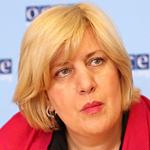
OSCE Media Freedom Representative Dunja Mijatovic pointed out that problems in Turkey stem from a lack of freedom to criticize the government, which is a problem encountered in other countries as well, and from the fear felt towards different opinions.
"I will continue my struggle at non-governmental organizations and before governments. Data bases on arrested journalists must be updated. There are positive indicators that the authorities are going to respond to our call. I am going to keep you informed about the developments", Mijatovic said.
The OSCE representative announced to share the problems of press freedom in a meeting with the European Commission on Thursday (5 May). "You are not alone, we are with you", she stressed. (EÖ/VK)


A graduate of the French Language and Literature Department at İstanbul University. He has served as the Turkey representative for the international organization Reporters Without Borders (RSF), where he began as a reporter in 1996. Since 1999, he has worked at bianet, a project of the IPS Communication Foundation, as the coordinator of the Legal Support Desk, editor for freedom of expression, and editor-in-chief. He has authored more than 4,800 signed news articles and opinion pieces. He has also written for Bizim Gazete and the journal Güncel Hukuk. He currently prepares the Media Monitoring Reports at bianet.

OSCE MEDIA FREEDOM REPRESENTATIVE
Crucial Problems: Detained Journalists and Censorship
KCK OPERATION
11 People in Police Custody in Adana - Also 2 Journalists

Declaration of the Freedom for Journalists Congress
BİA 2011 FIRST QUARTER MEDIA MONITORING REPORT
Freedom of Expression Defendants Name by Name

BİA MEDIA MONITORING REPORT
World Press Freedom Day Welcomed by 103 "Defendants of Opinion"
OSCE
Prison Threats Endanger Investigative Journalism in Turkey
EUROPEAN JOURNALISTS FEDERATION GENERAL ASSEMBLY
"Press Freedom is Information, not Criticism of the Government"
OSCE conference: Get Rid of Penal Code for the Media
OSCE MEDIA FREEDOM REPRESENTATIVE
Crucial Problems: Detained Journalists and Censorship
KCK OPERATION
11 People in Police Custody in Adana - Also 2 Journalists
Declaration of the Freedom for Journalists Congress
BİA 2011 FIRST QUARTER MEDIA MONITORING REPORT
Freedom of Expression Defendants Name by Name
BİA MEDIA MONITORING REPORT
World Press Freedom Day Welcomed by 103 "Defendants of Opinion"
OSCE
Prison Threats Endanger Investigative Journalism in Turkey
EUROPEAN JOURNALISTS FEDERATION GENERAL ASSEMBLY
"Press Freedom is Information, not Criticism of the Government"
OSCE conference: Get Rid of Penal Code for the Media
MAY 3 WORLD PRESS FREEDOM DAY
Journalism rights thrive on reader support!
BİA MEDIA MONITORING REPORT 2025
Those who want to silence journalists are now more brazen!
BİA MEDIA MONITORING OCTOBER-NOVEMBER-DECEMBER 2025
The future of journalism is in danger under government pressure!
BİA MEDIA MONITORING JULY-AUGUST-SEPTEMBER 2025
Prolonged detentions and judicial control tighten pressure on journalists
BİA MEDIA MONITORING APRIL-MAY-JUNE 2025
Unprecedented pressure on journalists under the government's watch