









Why Low Turnout at ESF March?
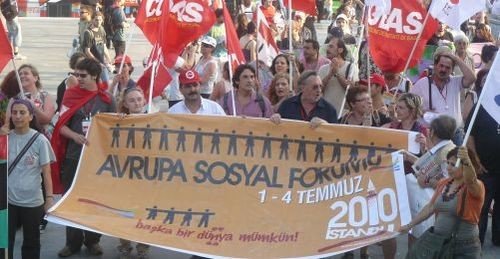



On Saturday, 3 July, around 3,000 people joined the march of the European Social Forum (ESF) in Istanbul.
The demonstrators walked from Osmanbey to Taksim Square to mark the sixth European Social Forum. Previous ESFs have taken place in Florence, Paris, London, Athens and Malmö.
Just as there is low participation in Turkish trade unions, the turnout at the ESF march was quite low.
bianet put the question "Why were we so few?" to Christian Mahieux of the French Union Syndicale Solidarité (Trade Union Solidarity), Alberto Matos of the Bloco de Esaguerda Portugal (Portuguese Left Block), Nevin Kaplan, the ESF representative of the KESK trade union confederation, Süleyman Çelebi, the chair of the DİSK trade union confederation and activist Hakan Tahmaz.
Mahieux: Permanent networks more important
Comparing this year's ESF to previous ones, Mahieux told bianet that the Istanbul gathering was more "deflated".
"Perhaps local authorities made difficulties, perhaps groups had their own problems. But participants of ESFs should go beyond these fun periodic activist meetings anyway, and rather create permanent networks of real relations."
Matos: Effects of global crisis
Matos from Portugal had previously joined the ESF in London in 2004, at a time when people were protesting against Tony Blair and the war. That ESF was more crowded than the one in Istanbul. He said,
"The global crisis has also affected trade unions. Many people from countries like Greece, Bulgaria and Romania may not have been able to come because of the effects of the crisis. From Portugal we are only 20 people this year."
Kaplan: Quality participation
Kaplan of the KESK confederation said that they had faced a lot of difficulties in the preparation of the forum, one of them being European prejudice.
"I accept that there has not been a high turnout, but we see quality participation. During meetings in June some European trade unions had the impression that we would not be able to organise this. We really have to work on breaking down these prejudices."
Çelebi of the DİSK confederation told bianet that discussing issues was as important as discussion participation numbers. He agreed that there was need for more collaborative work.
Tahmaz: The left is isolated
For activist Tahmaz, the low turnout was an indication of how isolated the left is.
He said that around 3,000 people had gone from Turkey to Greece for the Forum in 2004, but that the ESF has become less effective. (EÖ/AG)
