Multicultural Creativity In The Mediterranean
Gaza’s Art Flotilla



An international festival showcasing some of the latest world video art films sounds like an unlikely event in blockaded Gaza, but with an internet connection and lots of perseverance, a group of local artists are breaking the siege through what they do best.
"Everyone is thinking of breaking the siege by getting in materials and medicines," says Bael El Maqousi, one of the founders of the Windows of Gaza, a progressive group of young artists keen on connecting the coastal enclave to the world. "We thought we can do the same with art by bringing it to Gaza. Though this is not as important as food for ordinary people, we believe it is important at a conceptual level."
The attendance for the festival opening last June proves him right. No queues one would associate with lines of people waiting for food aid, but a respectable crowd that is hungry for food for the soul.
"We have organised this festival to open Gaza to the outside world and give Gazans an opportunity to watch contemporary art," said Majed Shala, another founder and one of the festival organisers.
While it is next to impossible to bring in pieces of art to Egypt - Israel bans movement of people and goods and Egypt allows only limited humanitarian aid - the artists decided that instead of receiving photographs of paintings to print and display, video art would be the best way to retain the originality of a piece.
"We try getting foreign artists' work here but it's very hard and when he print copies it's not the same thing, but through internet we could receive video art films and show them here," Shala adds. "We called on all artists in the world to send us their work, and participation was great."
To this end, the organisers invited artists from around the world to submit their entries by email. Artists from 30 countries submitted nearly 80 different films, from which the best 40 were selected to be shown across Gaza and the West Bank.
"Though one of the main aims of the festival is to break the siege, we did not want to limit the videos to this concept," says artist and festival organiser Shareef Sarhan. "We tried to invite all sorts of themes. The fact that those themes are coming to Gaza contributes to enlarging the perspective of Gaza's artists and exposing people to such art."
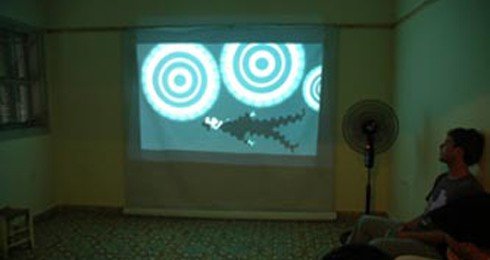
In Gaza City, the venue is a modest old house recently converted into an art studio and gallery by Windows of Gaza. As the first film is about to be shown, the lights go out in what is a daily occurrence here, but a mobile generator soon lights up the screen, albeit to a noisy background sound.
Under blockade, even art here suffers from the same problems faced by every other sector. Paint and raw material is scarce, of low quality and very expensive.
"We depend on material coming through the tunnels from Egypt," says Sarhan says. "Sometimes we have to ask anyone coming from Israel or Jerusalem or Ramallah to bring us material with them. I have some friends working with UNRWA, but not everyone is so lucky. No artist here can live on art, so we all have to have another job. There are no materials here, and no good places to hold exhibitions; maybe three spaces in all of Gaza.
"The idea of this project emerged out of Gaza's dire need for creating a cultural atmosphere to improve the Palestinian cultural scene which has been badly affected by the siege and isolation," Sarhan said. "The project also aims to bring new universal elements of art to Gaza to enrich the Palestinian culture which has witnessed a decline over the last few years."
Even the de facto Hamas government of Gaza does not help much. The Islamist movement is, at best, indifferent to anything that is not immediately religious or political within its own agenda.
"I have no work or cooperation with the ministry of culture, no contact," says Sarhan, who has participated in numerous exhibitions abroad in the past. "We don't really have problems with them. Government is not interested in art. Maybe they organise different activities falling under culture, but not art. We're not on the same wavelength... maybe even seeing women coming for this exhibition won't please them."
Like the rest of Palestinians in Gaza, artists remain confined to the narrow strip in a progressive deterioration of the political, economic, cultural and social aspects of life.
Shala last got out of Gaza in 2007, exactly three days before the Hamas coup and the ensuing blockade.
"Last year I was meant to travel four times abroad for exhibitions - to Italy, France, Cairo and Jordan - but every time I was refused a travel permit," he said. "An artist needs freedom, the liberty to roam, interact, see foreign lands and meet other people. That's why the kind of contacts we are making are essential for us. Were it not for the internet, the siege would be cutting us completely from the world and would have no idea what our fellow artists are doing abroad. Hopefully one day we will be able to host the artists themselves among us."(ÇT)

Multicultural Creativity In The Mediterranean
Hip-hop In France, From Street To Stage
Multicultural Creativity In The Mediterranean
Boultek, A Place of Hope
Multicultural Creativity In The Mediterranean
Absent Faces
Multicultural Creativity In The Mediterranean
Aadel Essaadani: Commitment And Vision
Multicultural Creativity In The Mediterranean
5 Hectares Of Culture In Casablanca
Multicultural Creativity In The Mediterranean
Nadir Leghrib: Grunge And Chaâbi Fusion
Multicultural Creativity In The Mediterranean
A Congolese in Istanbul Rebels Against Life Through His Songs

Multicultural Creativity In The Mediterranean
Kheireddine M’kachiche: Oriental Jazz
Multicultural Creativity In The Mediterranean
Mobility Of Artworks Instead Of Artists

Multicultural Creativity In The Mediterranean
Hip-hop In France, From Street To Stage
Multicultural Creativity In The Mediterranean
Boultek, A Place of Hope
Multicultural Creativity In The Mediterranean
Absent Faces
Multicultural Creativity In The Mediterranean
Aadel Essaadani: Commitment And Vision
Multicultural Creativity In The Mediterranean
5 Hectares Of Culture In Casablanca
Multicultural Creativity In The Mediterranean
Nadir Leghrib: Grunge And Chaâbi Fusion
Multicultural Creativity In The Mediterranean
A Congolese in Istanbul Rebels Against Life Through His Songs
Multicultural Creativity In The Mediterranean
Kheireddine M’kachiche: Oriental Jazz
Multicultural Creativity In The Mediterranean
Mobility Of Artworks Instead Of Artists