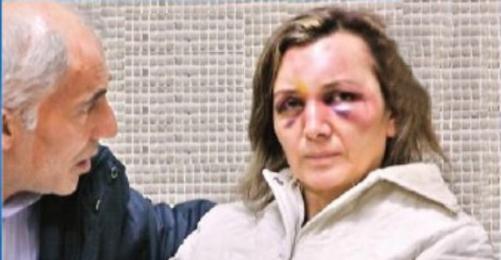
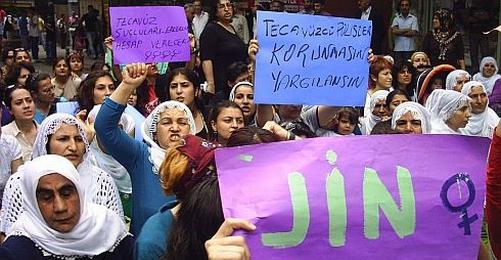



Members of the Istanbul Women Platform went to the street to protest against the rape of K.S., member of the Democratic Freedom Women Movement (DÖKH). K.S. had been kidnapped by plain clothes police officers and exposed to sexual violence eleven days ago (17 June). According to the women, the case of K.S. is not a single incident but has to be seen as part of a large-scale problem.
About 50 women met at the Bağcılar (Istanbul) tram station from where K.S. had been kidnapped. They planned to walk to the district governorship. Yet, when the police refused permission for the protest march, the women started a sit-down strike on the road and thus blocked traffic.
"Our friend was kidnapped and raped. The rapist police officers should be prosecuted" was written on a banner. The women shouted slogans such as "Long live women's solidarity", "Stop harassment in detention, stop rape" or "The rapist police officers will be called to account".
Platform member Alev Arslan read out the press release issued by the Istanbul Women Platform.
Arslan argued that raping and abusing women that are organized in the opposition in Turkey was a part of the government's policies. "We will not remain silent against abuse and rape of women", she declared.
"Increase of violence and rape of women not a coincidence"
The statement included the following points:
- Sexual torture in Turkey is used as a means of a systematic policy of deterrence, a war strategy and a way of oppressing and punishing women that are carrying out struggles in various areas.
- The state was using sexual torture for 30 years against revolutionary women after 12 March (military coup in 1971) and 12 September (military coup in 1980) and against Kurdish women. This policy of deterrence has been implemented again.
- In the course of a recent increase of violence and military operations against Kurds, some people trust in the fact that they will not be revealed and prosecuted as perpetrators of sexual violence that has its origin in the state. They decided to silence Kurdish women with means of sexual abuse and rape.
- It is not a coincidence that violence against women and the number of rape cases increase just when the war is escalating, operations become more violent and the touts of war call for blood.
- We will not remain silent against abuse and rape. We know who kindnapped our friend on 17 June, we know who exposed her to ten hours of sexual torture and rape. We will not stop following the rapists.
"Let's not talk, let's not give ourselves away"
Four people with a white Fiat Doblo stupefied DÖKH member K.S. and forced her into their car on 17 June in Bağcılar. According to K.S.'s statement, one of the attackers told her, "Who do you think you are? We have been following you for two months. Finally, we got you". Another attacker apparently said, "Let's not talk, let's not give away ourselves". The attacker took K.S. to an abandoned ramshackle building where she was exposed to rape and sexual violence for ten hours. (BB)
* Photograph: Nilgün Yurdalan