Kurdish Initiative
Minister Atalay Listens to Journalists' Suggestions

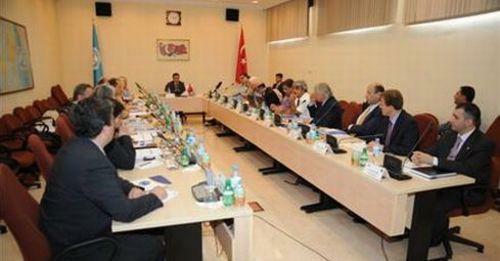



Minister of the Interior Beşir Atalay, who is coordinating the government's work towards a solution of the Kurdish question, met with journalists and academics for a five-hour discussion.
In a previous press conference he had stated that the government would seek dialogue with all sections of society on the issue and would work on developing democracy, rights and freedoms.
The workshop was held on Saturday, 1 August, at the Police Academy in Ankara. It was joined by Police Academy president Zühtü Arslan, Police Academy research centres' president İhsan Bal, several academics, and journalists Deniz Ülke Arıboğan, Fehmi Koru, Hasan Cemal, Cengiz Çandar, Oral Çalışlar, Mustafa Karaalioğlu, Ruşen Çakır, Muharrem Sarıkaya, İbrahim Kalın, Okan Müderrisoğlu, Nasuhi Güngör, Mithat Sancar, Ali Bayramoğlu, İhsan Dağı and Mümtaz'er Türköne.
According to the Milliyet newspaper, Hürriyet newspaper's editor-in-chief Ertuğrul Özkök had excused himself from the meeting.
Of the 21 people attending, 20 were men.
The workshop was divided into two sessions, entitled "Things that Need to Be Done in the Process: Method and Managament" and "What Needs to Be in the Democratisation Package?"
Arslan said in a statement after the workshop that the brainstorming would be repeated with other segments of society.
Participants' views
Some of participants commented on the workshop. Their comments are summarised here:
Ruşen Çakır, NTV: Perhaps people were only repeating opinions that are already known, but it was a very liberal climate. The state seems decisive. Some of the journalists who joined were hopeful. Some people commented on what position the Nationalist Movement Party (MHP) might take. Because this is my opinion, I can comfortably say that I don't think the MHP will be able to obstruct the process very much. There was also discussion about the role of the Republican People's Party (CHP). Some believed that because general elections are close [2011], the current parliament will have difficulties in carrying out the project. But there was general agreement that parliament was the place to deal with the issue.
Cengiz Çandar, Radikal newspaper: There was no discussion on the PKK and on whether (its imprisoned leader) Abdullah Öcalan should be talked to. Let use hope that a process has begun which will relieve Turkey within a few months.
Hasan Cemal, Milliyet newspaper: This meeting was a first. It is a serious indication that some things have changed in the state. I can say that there are serious things cooking in the kitchen.
Mümtaz'er Türköne, Zaman newspaper: The "democratisation initiative" foresaw a process of negotiation to be gone through with patents. The workshop yesterday should be considered the first step in this negotiation process.
Okan Müderrisoğlu, Sabah newspaper: Dominant views at the meeting were: "This is Turkey's problem, and we have to solve it. We have a historical opportunity, but there is a risk of provocation. First arms must be silenced, then arms must be laid down. The paradigma of the republic must change. The Kurdish people must be included in the dialogue. It must not be ignored that the MHP's attitude may harden. The President and parliament must play active roles. If the process is not well-managed, the fighting in the east may move to the west."
MHP and CHP critical
Meanwhile, the main opposition parties have expressed their disagreement. Onur Öymen from the CHP has criticised the "initiative" for its lack of clear content, while Devlet Bahçeli, leader of the MHP, accused the government of trying to split up the country in the name of democratisation. (EÜ/AG)
This news item used information from NTV, ntvmsnbc, CNNTürk and journalists' columns.


Analysis by Zafer YÖRÜK
Kurdish Question: Lessons to Be Learnt from Northern Ireland
Government's "Kurdish Initiative"
Minister Atalay Meets with TOBB
Kurdish question and mhp
"MHP and CHP Should Be Most Supportive of Kurdish Initiative"
kurdish question
Minister Atalay Speaking to Political Parties about Initiative
Kurdish Question
"Real Issue Is PKK's Participation in Legal Politics"
"Party Leader" Erdoğan Finally to Meet Kurdish MPs
ERTUĞRUL KÜRKÇÜ On Government's Kurdish İnitiative
Possibility of a "Solution" Needs to Be Taken Seriously
Freedom of Expression a Must for Discussion of Kurdish Question

Kurdish Question
Diyarbakır Hopeful after Minister's Speech
Kurdish question
Minister Atalay: "We Will Speak to Anyone for a Solution"
Analysis by Zafer YÖRÜK
Kurdish Question: Lessons to Be Learnt from Northern Ireland
Government's "Kurdish Initiative"
Minister Atalay Meets with TOBB
Kurdish question and mhp
"MHP and CHP Should Be Most Supportive of Kurdish Initiative"
kurdish question
Minister Atalay Speaking to Political Parties about Initiative
Kurdish Question
"Real Issue Is PKK's Participation in Legal Politics"
"Party Leader" Erdoğan Finally to Meet Kurdish MPs
ERTUĞRUL KÜRKÇÜ On Government's Kurdish İnitiative
Possibility of a "Solution" Needs to Be Taken Seriously
Freedom of Expression a Must for Discussion of Kurdish Question
Kurdish Question
Diyarbakır Hopeful after Minister's Speech
Kurdish question
Minister Atalay: "We Will Speak to Anyone for a Solution"
SOCIAL GENDER EQUALITY
Women and Journalists Hand in Hand against Violence
EUROPEAN COMMISSION AGAINST RACISM AND INTOLERANCE
Discrimination and Racism in Turkey Fuel Concern

Unionists in Northern Cyprus Protest PM Erdoğan
Policeman who Beat Juvenile Claimed Self-Protection
HRANT DINK MURDER
Court fully Protects Istanbul Police