





Dink Murder Case
European Lawyers Will Monitor Every Hearing



Today, 6 July, the tenth hearing of the Hrant Dink murder case is taking place at the Istanbul 14th Heavy Penal Court.
The hearing is being attended by Vincent Niore from the Paris Bar Association, Alexandre Aslanian from the Union of French Lawyers with Armenian Origin (AFAJA) and Yves Oschinsky, president of the Brussels Bar Association.
Niore told bianet that a delegation of European bar lawyers will attend every hearing: "From now on, we intend to observe the trial with other bar associations in Europe."
Demand for justice
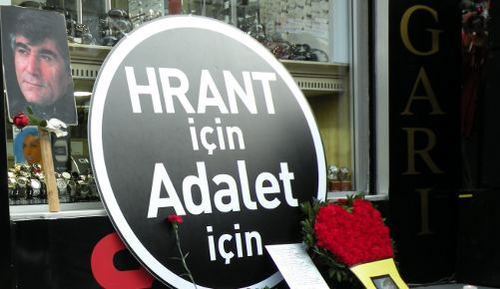
Niore took part in the "chain of conscience" that was formed in Beyoğlu on Saturday to demand the trial of all those responsible for the murder of Turkish-Armenian journalist Hrant Dink on 19 January 2007.
He said he was "deeply affected" by the display of brotherhood and friendship at the event.
Following the murder of Hrant Dink, the trial began on 2 July 2007. Although gross negligence, if not worse, has been suspected to have taken place within the intelligence and security forces, no public official is no trial in the main murder case.
Eight gendarmerie officers are being tried in a separate case, the merger of which with the main case has been demanded repeatedly by the Dink family lawyers. The officers are being tried for negligence.
ECHR has begun to consider the case
The European Court of Human Rights (ECHR) has collected and merged applications concerning the case and has directed a list of questions at Turkey, to be answered by November.
Because complaints about negligence in the murder did not bring any results, lawyers have appealed to the ECHR, which is now examining files on the Trabzon, Istanbul and Samsun police force and the Trabzon gendarmerie.
The court has asked Turkey whether the state fulfilled its duty of protecting the life of Hrant Dink, and whether the journalist was discriminated against because he was a citizen of Armenian origin.
Prior to his murder, the editor of the weekly Turkish-Armenian Agos newspaper was handed a suspended six-month prison sentence under Article 159 of the Turkish Penal Code for a series of articles entitled "Armenian identity".
At a time when he was facing more and more threats on his life, he appealed to the ECHR against the sentence. Two weeks later, he was killed.
After his death, family lawyers added further appeals to the ECHR because no officials from the Trabzon police or gendarmerie or the Istanbul police have been taken to court.
The last application to the ECHR concerned the "souvenir pictures" which Samsun police officers took of suspected gunman Ogün Samast after catching him at the Samsun bus station in the night of 20 January 2007. No officer was tried. (EÖ/TK/AG)
Click here for pictures of the gathering of "Hrant Dink's Friends" prior to the court hearing in Beşiktaş.


A graduate of the French Language and Literature Department at İstanbul University. He has served as the Turkey representative for the international organization Reporters Without Borders (RSF), where he began as a reporter in 1996. Since 1999, he has worked at bianet, a project of the IPS Communication Foundation, as the coordinator of the Legal Support Desk, editor for freedom of expression, and editor-in-chief. He has authored more than 4,800 signed news articles and opinion pieces. He has also written for Bizim Gazete and the journal Güncel Hukuk. He currently prepares the Media Monitoring Reports at bianet.

HRANT DINK MURDER
Will State Intelligence Bring Light into Dink Murder Case?
Dink Murder Trial
Court Finally Hears Defendant's Threats
Dink Murder Trial
Witnesses: "Gunman Was Not Alone"
Two Years On: Lawyers Summarise Dink Trial

Chronology II: Hrant Dink’s Murder
HRANT DINK MURDER
Will State Intelligence Bring Light into Dink Murder Case?
Dink Murder Trial
Court Finally Hears Defendant's Threats
Dink Murder Trial
Witnesses: "Gunman Was Not Alone"
Two Years On: Lawyers Summarise Dink Trial
Chronology II: Hrant Dink’s Murder
MAY 3 WORLD PRESS FREEDOM DAY
Journalism rights thrive on reader support!
BİA MEDIA MONITORING REPORT 2025
Those who want to silence journalists are now more brazen!
BİA MEDIA MONITORING OCTOBER-NOVEMBER-DECEMBER 2025
The future of journalism is in danger under government pressure!
BİA MEDIA MONITORING JULY-AUGUST-SEPTEMBER 2025
Prolonged detentions and judicial control tighten pressure on journalists
BİA MEDIA MONITORING APRIL-MAY-JUNE 2025
Unprecedented pressure on journalists under the government's watch