Four-Hour Broadcasting In Kurdish Is Not Enough



The Prime Minister Recep Tayip Erdoğan, who was in Diyarbakır to announce the five-year “GAP Action Plan”, said that they set apart a channel of Turkish State Television (TRT) for broadcasting in non-Turkish languages and that it will begin broadcasting very soon.
The Prime Minister stated that the media was publishing in non-Turkish languages and TRT has recently restructured itself to broadcast in Kurdish, Circassian, Bosnian, Zaza and Arabic during their time. He further added that their government’s determination for improving democracy and the quality of life would continue and that the development of the non-governmental organizations (NGO) had their utmost priority.
Keser: Our broadcasting goes on with the same restrictions
Diren Keser, the production director of GünTV, the Kurdish TV channel, the one mentioned in Prime Minister’s speech as the channel broadcasting in Kurdish, says that they are not broadcasting under comfortable conditions. He reminds that the regulation about radio and television broadcasting in different languages and dialects the Turkish citizens traditionally use in their daily lives, which went into effect on January 25, 2004, brought many restrictions.
Keser says that the Prime Minister gave the same speech he did four months ago, but the regulations have not changed since then.
They are broadcasting four hours a week, forty-five minutes a day and programs for teaching Kurdish or for children cannot be made in this amount of time. Their programs consist of news, music and the traditional culture.
Asking for the removal of the obligation of subtitles, Keser says that the four-hour restriction may seem adequate for İstanbul, but it is certainly not for Diyarbakır.
On TRT the Kurdish news are old, the people of Diyarbakır watch Gün TV
Emphasizing that they are the only one broadcasting in Kurdish among 500 media organization, Keser says that the other organizations cannot start broadcasting in Kurdish because of the restrictions.
Regarding the promise the Prime Minister made about having TRT start non-Turkish programs, including Kurdish, he says that first the regulations must change.
About the TRT news program in Kırmanci language, a Kurdish language, he says that the news is old. Continuing, he adds that the news have to be current. “Considering the capabilities of TRT”, he points out, “the programs can be much better. However, even in that case, the person in Diyarbakır watches Gün TV, not TRT.
Broadcasting in mother language has not been easy
The right to broadcast in different languages other than Turkish in local and national media went into effect in 2004. Only Gün TV among the four institutions which got the permission to broadcast in Kurdish are still broadcasting in Kurdish.
On June 7, 2004, TRT Radio 1 and TRT 3 television channel started broadcasting in Bosnian on Mondays, Arabic on Tuesdays, Kırmanci on Wednesdays, Circassian on Thursdays and in Zaza on Fridays. (EÖ/GG/TB)


A graduate of the French Language and Literature Department at İstanbul University. He has served as the Turkey representative for the international organization Reporters Without Borders (RSF), where he began as a reporter in 1996. Since 1999, he has worked at bianet, a project of the IPS Communication Foundation, as the coordinator of the Legal Support Desk, editor for freedom of expression, and editor-in-chief. He has authored more than 4,800 signed news articles and opinion pieces. He has also written for Bizim Gazete and the journal Güncel Hukuk. He currently prepares the Media Monitoring Reports at bianet.

A Seven Year Wait for Native Language Broadcasting
Diyarbakır’s Gün TV Punished with Programme Ban

Private Radio To Broadcast Non-Musical Program In Kurdish

Turkish State TV To Broadcast In Kurdish

“Kurdish TV Channel” Becomes Possible On Paper

Gün TV: Kurdish Broadcasts Difficult

Kurdish Radio-TV Broadcasts Start
Kurdish Broadcasts Began Different
Languages Other than Turkish on TV and Radio
First Kurdish Film on Gun TV
A Seven Year Wait for Native Language Broadcasting
Diyarbakır’s Gün TV Punished with Programme Ban
Private Radio To Broadcast Non-Musical Program In Kurdish
Turkish State TV To Broadcast In Kurdish
“Kurdish TV Channel” Becomes Possible On Paper
Gün TV: Kurdish Broadcasts Difficult
Kurdish Radio-TV Broadcasts Start
Kurdish Broadcasts Began Different
Languages Other than Turkish on TV and Radio
First Kurdish Film on Gun TV
MAY 3 WORLD PRESS FREEDOM DAY
Journalism rights thrive on reader support!
BİA MEDIA MONITORING REPORT 2025
Those who want to silence journalists are now more brazen!
BİA MEDIA MONITORING OCTOBER-NOVEMBER-DECEMBER 2025
The future of journalism is in danger under government pressure!
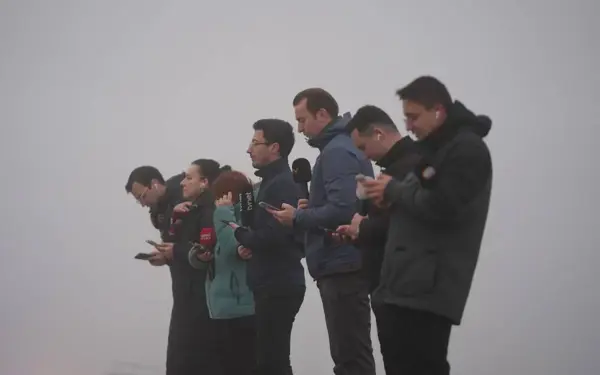
BİA MEDIA MONITORING JULY-AUGUST-SEPTEMBER 2025
Prolonged detentions and judicial control tighten pressure on journalists
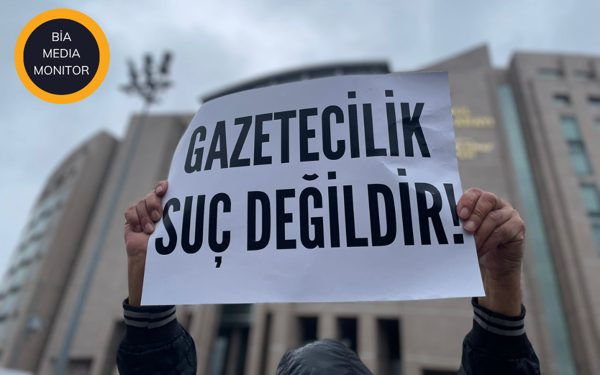
BİA MEDIA MONITORING APRIL-MAY-JUNE 2025
Unprecedented pressure on journalists under the government's watch