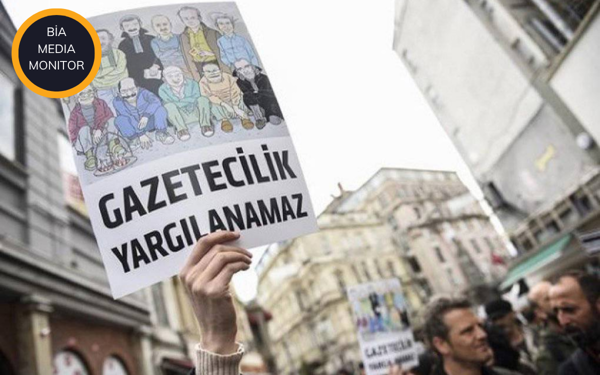






Writer Demirer on Trial for "Armenian Genocide"



A day after journalist Hrant Dink’s murder on 19 January 2007, writer Temel Demirer read a press statement in central Ankara, saying that the journalist had not only been killed for being Armenian, but also because he had spoken of an “Armenian genocide.”
Trial under Articles 301 and 216
Around a year later, Demirer has been taken to court under Article 301 and 216 for “denigrating the Turkish Republic” and “inciting to hatred and hostility.” The case will be heard at the Ankara 2nd Penal Court tomorrow (6 March).
Temel Demirer and the Solidarity Initiative had said, “We owe something to those being tried for their thoughts and actions, those being obstructed, tortured, imprisoned and killed.”
In a previous statement Demirer said that he believed that there was a genocide carried out against the Armenians in the Ottoman period, that the state was then the “modus operandi of the Committee of Union and Process”, and that this custom had been continued up to cases like the Susurluk scandal (which revealed connections between the state and contract killings).
Calling on others to commit "crimes" in protest
The indictment prepared by Chief Public Prosecutor Levent Savas on 24 December 2007 is based on police reports and police recordings. According to the indictment, Demirer said the following at the protest meeting:
“We live in a country where murders and silencing the truth are partners. Hrant was murdered not only because he was Armenian but because he said expressed the reality that a genocide took place in this country. If the Turkish intellectuals do not commit 301 crimes under Article 301, then they will be guilty of Hrant’s murder, too."
"There is a genocide in our history, it is called the Armenian genocide. At the cost of his life, Hrant told us all about this reality. Those who do not commit a crime against the murderous state are part of the murder. Those who killed the Armenians yesterday are today attacking our Kurdish brothers and sisters. Those who want the brotherhood of peoples need to face up to this history. We have to commit crimes to avoid that what happened to the Armenians happens to the Kurds. I call on all of you to commit crimes. Yes, there was an Armenian genocide in this country."
The statement was signed by the following:
Fikret Başkaya, İsmail Beşikçi, Yüksel Akkaya, Mehmet Özer, Necmettin Salaz, Ahmet Telli, Ruşen Sümbüloğlu, Tayfun İşçi, Mahmut Konuk, İbrahim Akyol, Abdullah Aydın, Oktay Etiman, Sait Çetinoğlu, Halil İbrahim Vargün, Özgen Seçkin, Zişan Kürüm, Mete Kaan Kaynar, Hakkı Atıl, Mustafa Kahya, Anıl Aslan, Hüseyin Ontaş, Erol Bıyıklı, Cennet Bilek, Serpil Köksal, Selçuk Kozağaçlı, H. İbrahim Vargün, Evrim Kılıç, Yılmaz Erdoğan, Pınar Dursun, Samet Erdemir, Özer Akkuş, Özgür Doğan, Mehmet Toğan, Ramazan Gezgin, Metin Uzunöz, Onur Işık, Hüseyin Gevher, Ülkü Çevik, Hüseyin Güngör, Muzaffer Çelikkol, Rıza Karaman, Metin Ayhan, İrfan Kaygısız, Çağdaş Küpeli, Devrim Kahraman, Tülay Koçak, Ali Ersin Gür, Muharrem Demirkıran, Haldun Açıksözlü, Adil Okay, Confederation of Europe Workers from Turkey (ATIK) (EÖ/GG)


A graduate of the French Language and Literature Department at İstanbul University. He has served as the Turkey representative for the international organization Reporters Without Borders (RSF), where he began as a reporter in 1996. Since 1999, he has worked at bianet, a project of the IPS Communication Foundation, as the coordinator of the Legal Support Desk, editor for freedom of expression, and editor-in-chief. He has authored more than 4,800 signed news articles and opinion pieces. He has also written for Bizim Gazete and the journal Güncel Hukuk. He currently prepares the Media Monitoring Reports at bianet.

CATHEDRAL OF THE HOLY CROSS
Armenian Christians Celebrate First Mass after 95 Years in Akdamar
Dink Family Lawyers to Appeal to ECHR
Not Many New Approaches for Armenian Issue
1915s Memory Confuses Turks
Apology Campaign to Be Investigated

Justice Minister's Comments Jeopardize Article 301 Suspect Temel Demirer’s Safety

Armenian and Turkish Intellectuals Debate "24 April 1915"

Agos Newspaper Interview with Kürkçü on Armenian Question

Racist Film in Schools: Lawyer Calls on Parents to Sue

Chronology II: Hrant Dink’s Murder
CATHEDRAL OF THE HOLY CROSS
Armenian Christians Celebrate First Mass after 95 Years in Akdamar
Dink Family Lawyers to Appeal to ECHR
Not Many New Approaches for Armenian Issue
1915s Memory Confuses Turks
Apology Campaign to Be Investigated
Justice Minister's Comments Jeopardize Article 301 Suspect Temel Demirer’s Safety
Armenian and Turkish Intellectuals Debate "24 April 1915"
Agos Newspaper Interview with Kürkçü on Armenian Question
Racist Film in Schools: Lawyer Calls on Parents to Sue
Chronology II: Hrant Dink’s Murder
MAY 3 WORLD PRESS FREEDOM DAY
Journalism rights thrive on reader support!

BİA MEDIA MONITORING REPORT 2025
Those who want to silence journalists are now more brazen!

BİA MEDIA MONITORING OCTOBER-NOVEMBER-DECEMBER 2025
The future of journalism is in danger under government pressure!
BİA MEDIA MONITORING JULY-AUGUST-SEPTEMBER 2025
Prolonged detentions and judicial control tighten pressure on journalists
BİA MEDIA MONITORING APRIL-MAY-JUNE 2025
Unprecedented pressure on journalists under the government's watch