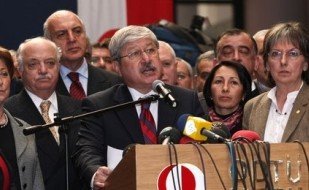
Peace Parliament: Solve Kurdish Question in 2008



In a New Year’s message, the Peace Parliament addressed the unresolved Kurdish question:
“As a first step towards peace, the Turkish Peace Parliament invites the government to give up its assimilationist policies, to accept different identities, and to offer the resources to develop these identities. The [planned] constitutional reform is very important in this respect.”
Peaceful and political solution needed
The statement further said that the Kurdish question was one of the most important factors influencing peace in Turkey, and emphasised that the issue urgently needed to be solved in a peaceful and political manner:
“ Similar attempts in the past have shown that the Justice and Development Party (AKP) will not be able to solve the problem by trying to improve Article 221, related to ‘remorse'. Legal and economic plans which do not aim at democratisation and political freedom show that the policy of assimilation is being continued in the area.”
The statement argued that the violence used and the policy of conflict have caused deaths and have increased suffering.
“We invite the government to end cross-border operations and tensions and to implement a peace project which will solve the Kurdish question within the borders of the country and with the dynamics of this country. The conflict is pulling the government towards a state of emergency. Those who oppose the official discourse are being branded as proponents of violence or as terrorists.”
Rising nationalism
“This attitude which feeds and supports the rising nationalism has made targets out of political parties of the opposition, of NGOs, academics and human rights activists.”
“After the murder of Hrant Dink, Turkey is again being perceived as a country in which political murders can be carried out. Three Christians were killed in Malatya. The accusations made against the [pro-Kurdish] Democratic Society Party (DTP), which formed a group in parliament, have turned into political lynching.”
Police violence and biased judiciary
The Peace Parliament pointed out that the police had been given more powers, which had resulted in the use of excessive force, threatening the right to life.
“There were seven deaths in detention and prisons in 2007, two of them caused by police guns. There has been an increase in torture and maltreatment cases, and the methods of violence have become more extreme. In order to guarantee social peace, we invite the government to respect the values and criteria of a state of law which is based on human rights.”
The statement further called on effective investigations into crimes committed by members of the security forces, and a neutral and independent judiciary process.
The Peace Parliament further announced that it would found organisations all over Turkey and thus increase its effectiveness. “There will be activities, and solutions will be developed. We wish all our people and the world fair and sustained peace, health and happiness.” (GG/TK/AG)

254 Deaths Since Ground Operations Started
Kurdısh Questıon
President Gül’s Speech “Has Created Hope in Diyarbakır”
Anti-Operations March in Istanbul Stopped by Police
Turkey Peace Parliament: Results Report
Kurdish Question
Conference for Dialogue on Kurdish Issue in Istanbul

Newspaper Investigated for Anti-Militarist Support
Peace Initiative: Operations Not the Solution

Iraq Calls on Turkey to Withdraw Soldiers

IHD Activists Call for “Peace” in Many Languages
Nationalist Uproar at Singer’s Anti-War Stance

254 Deaths Since Ground Operations Started
Kurdısh Questıon
President Gül’s Speech “Has Created Hope in Diyarbakır”
Anti-Operations March in Istanbul Stopped by Police
Turkey Peace Parliament: Results Report
Kurdish Question
Conference for Dialogue on Kurdish Issue in Istanbul
Newspaper Investigated for Anti-Militarist Support
Peace Initiative: Operations Not the Solution
Iraq Calls on Turkey to Withdraw Soldiers
IHD Activists Call for “Peace” in Many Languages
Nationalist Uproar at Singer’s Anti-War Stance
AKP: “Closure Trial will Give Us 70 Percent of the Vote”
Reactions to AKP Closure Request
Peace Initiative: Operations Not the Solution
IPS Communications Foundation and Press Now Organised Workshop in Antalya
Headscarves Not “In the Clear” Yet