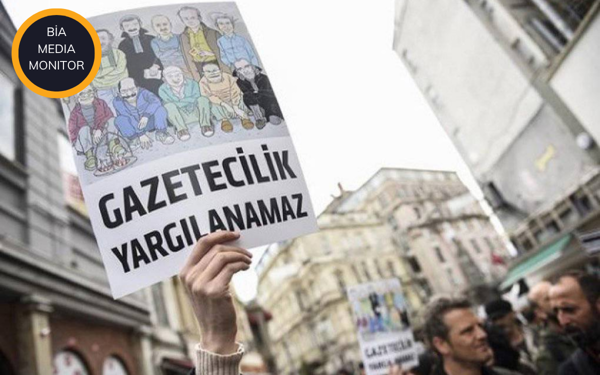
Freedom of Expression Cases Continue



For example, Turkey's Supreme Court of Appeals recently overturned the conviction of writer Selahattin Aydar from the "Milli Gazete" (National Newspaper) and introduced a broader outline for the notion of "public order" in terms of thought an freedom of expression.
Acquittals from Articles 159 and 312
Yasar Camyar, the former chief editor of "Alinterimiz" newspaper, who was arrested on December 17 based on Article 159 of TCK, was released on February 7. Writer Cevher Ilhan of the "Yeni Asya" (New Asia) newspaper, who was sentenced based on Article 132 of the TCK, for a piece about the Marmara earthquake, was released on January 15. The two acquittals were positive developments in Turkey, which has for years, been one of the countries with the highest number of imprisoned journalists.
The acquittal of Selahattin Demirtas, head of the Diyarbakir branch of the Human Rights Association (IHD), who stood trial for criticizing the inclusion of KONGRA-GEL in the list of terrorist organizations in Europe, was acquitted in January 24. That also served as an example that Turkish courts have begun to take into account the European Union reforms. Demirtas had been charged with "praising an action deemed crime by law".
Cases in Tunceli and Istanbul
The prosecutor's office in Tunceli twice decided that there is lack of grounds for legal action as a response to complaints filed by Paramilitary Police Regiment Commandership against journalist Huseyin Aygun. The prosecutors' office decision was an exception compared to the previous years.
The commandership filed complaint against Aygun, the owner of "Munzur Haber", twice for citing a news titled, "they burned down my house," and an IHD report on local officials being threatened.
Aygun is also being charged for "insulting the republic," and "praising an action deemed crime by law," for defending the right to receive education in mother tongues during 2002 Newroz celebrations. Aygun, who is also being accused with "criticizing implementations in Tunceli and in the country, and encouraging the crowds to chant slogans," will stand his first hearing on March 29.
On March 9, another hearing took place on the case against Ferhat Tunc, who is being charged with "insult" for criticizing the continued conviction of Leyla Zana and other former deputies of the closed-down Democracy Party (DEP). Editor-in-chief Mehmet Colak and Tunc, who described the Zana case as "political" in his article for the "Yeniden Ozgür Gundem" (Free Agenda Again) newspaper, face up to three years in prison.
"Membership in an illegal organization" is still a problem
Accusing journalists with "membership in an illegal organization" has been a problem for many years. There were seven media employees among the 46 people detained and arrested during the demonstration by the Socialist Platform of the Oppressed about three months ago. The demonstrators were protesting the draft Penal Execution Law. The journalists will stand the first hearing on March 11 in an Ankara court.
Austrian journalist Sandra Bakutz, who is currently at the Ulucanlar prison in Ankara, is also being accused with membership in an illegal organization. She will have a hearing on March 30th at the Heavy Penal Court in Ankara. The accusation is putting Turkey in a difficult position. The Reporters Without Frontiers (RSF) sent a letter to Justice Minister Cemil Cicek arguing that Bakutz is arrested without a solid charge and that she is not being tried transparently.


A graduate of the French Language and Literature Department at İstanbul University. He has served as the Turkey representative for the international organization Reporters Without Borders (RSF), where he began as a reporter in 1996. Since 1999, he has worked at bianet, a project of the IPS Communication Foundation, as the coordinator of the Legal Support Desk, editor for freedom of expression, and editor-in-chief. He has authored more than 4,800 signed news articles and opinion pieces. He has also written for Bizim Gazete and the journal Güncel Hukuk. He currently prepares the Media Monitoring Reports at bianet.

MAY 3 WORLD PRESS FREEDOM DAY
Journalism rights thrive on reader support!
BİA MEDIA MONITORING REPORT 2025
Those who want to silence journalists are now more brazen!
BİA MEDIA MONITORING OCTOBER-NOVEMBER-DECEMBER 2025
The future of journalism is in danger under government pressure!
BİA MEDIA MONITORING JULY-AUGUST-SEPTEMBER 2025
Prolonged detentions and judicial control tighten pressure on journalists
BİA MEDIA MONITORING APRIL-MAY-JUNE 2025
Unprecedented pressure on journalists under the government's watch