





ECHR Warns: Do Not Prevent Workers from Organising

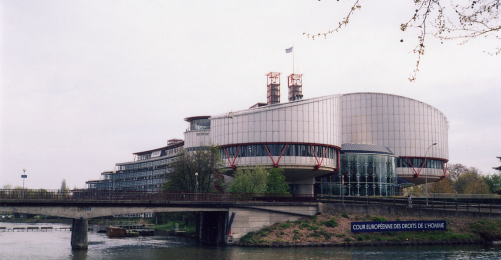



The European Court of Human Rights (ECHR) decreed on 21 April that Turkey violated Article 11 of the European Convention on Human Rights when members of the Enerji Yapı-Yol trade union were given disciplinary punishments.
The court of seven judges, one of them Judge Işıl Karakaş from Turkey, unanimously convicted Turkey and awarded the trade union 1,500 Euros legal costs.
The trade union was founded in Ankara in 1992, representing workers in the energy, land registry and road building sectors. It is a member of the Confederation of Public Workers’ Unions (KESK).
Strike ban
In a circular published on 13 April 1996, trade union members were forbidden from joining a one-day national strike organised by KESK as part of a programme of activities to achieve labour agreements.
However, five days later, members of the trade union’s management board joined the strike, ignoring the circular.
They were then handed disciplinary punishments. When efforts to have the punishments revoked prove fruitless, the trade union appealed to the ECHR on 1 September 2000. On 31 January 2008, the ECHR announced that it had accepted the complaint.
The court referred to a previous decree concerning Turkey and two trade unionists from Tüm Bel Sen on 21 November 2008.
In that case, concerning Vicdan Baykara, the trade union’s president, and trade union member Kemal Demir, Turkey had been sentenced to paying 20,500 Euros compensation.
It pointed out, inter alia, that the impugned circular had been adopted five days before the action planned by the Federation of Public-Sector Trade Unions, at a time when work was under way to bring Turkey’s legislation into line with international conventions on the trade-union rights of State employees and the legal situation of public servants was unclear.
Circular too general
The Court acknowledged that the right to strike was not absolute and could be subject to certain conditions and restrictions. However, while certain categories of civil servants could be prohibited from taking strike action, the ban did not extend to all public servants or to employees of State-run commercial or industrial concerns. In this particular case the circular had been drafted in general terms, completely depriving all public servants of the right to take strike action.
Furthermore, there was no evidence that the national action day on 18 April 1996 had been prohibited. In joining in the action the members of the applicant trade union had simply been making use of their freedom of peaceful assembly.
In the Court’s view the disciplinary action taken against them on the strength of the circular was capable of discouraging trade-union members and others from exercising their legitimate right to take part in such one-day strikes or other actions aimed at defending their members’ interests. Furthermore, the Turkish Government had failed to justify the need for the impugned restriction in a democratic society.
The Court found that the adoption and application of the circular did not answer a “pressing social need” and that there had been disproportionate interference with the applicant union’s rights. There had therefore been a violation of Article 11. (EÖ/AG)


A graduate of the French Language and Literature Department at İstanbul University. He has served as the Turkey representative for the international organization Reporters Without Borders (RSF), where he began as a reporter in 1996. Since 1999, he has worked at bianet, a project of the IPS Communication Foundation, as the coordinator of the Legal Support Desk, editor for freedom of expression, and editor-in-chief. He has authored more than 4,800 signed news articles and opinion pieces. He has also written for Bizim Gazete and the journal Güncel Hukuk. He currently prepares the Media Monitoring Reports at bianet.


MAY 3 WORLD PRESS FREEDOM DAY
Journalism rights thrive on reader support!
BİA MEDIA MONITORING REPORT 2025
Those who want to silence journalists are now more brazen!
BİA MEDIA MONITORING OCTOBER-NOVEMBER-DECEMBER 2025
The future of journalism is in danger under government pressure!
BİA MEDIA MONITORING JULY-AUGUST-SEPTEMBER 2025
Prolonged detentions and judicial control tighten pressure on journalists
BİA MEDIA MONITORING APRIL-MAY-JUNE 2025
Unprecedented pressure on journalists under the government's watch