





Şırnak Prosecution Finally Looking for “Death Wells”



Following the application of relatives of around 70 people who have been missing, the Şırnak Bar Association had called on a prosecutor from Silopi, a district in Şırnak, to start an investigation.
Sites of mass graves
Şırnak is a Kurdish-majority province in the southeast of Turkey, and hundreds of people have disappeared in the years of the conflict between the PKK and the military.
The recent investigation into the underground ultranationalist Ergenekon organisation, as well as statements from other people, have pointed to the existence of mass graves of people who were tortured and killed.
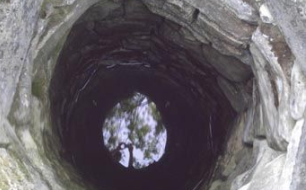
Wells of the Turkish Pipeline Corporation BOTAŞ are said to have been used by a special clandestine unit of the Gendarmerie to dump bodies that had been burnt with acid.
Yesterday (19 February), Silopi prosecutor Atilla Öztürk investigated on a military compound at the BOTAŞ site, as well as points at the roadside between the district towns of Cizre and Silopi in order to find the sites of these wells.
Permission will be requested to dig for bodies
A source at the Şırnak Bar Association told bianet that a report on the field examination would be added to the file, which would then be sent to a specially authorised prosecutor in Diyarbakır. This prosecutor’s office would have to give permission for the opening of wells.
The survey of the sites was joined by lawyers for relatives of the disappeared. Representatives of the Human Rights Association (IHD) and relatives of the missing persons were not admitted onto the military site.
The Şırnak Bar Association has also voiced suspicions that many of the missing persons were buried in a graveyard for the poor in Silopi; they have called for an investigation and an opening of graves.
Nuşirevan Elçi, president of the Şırnak Bar Association, said after the three-hour survey: “Of course we are now hoping that they will decide to open the wells. Today we examined the BOTAŞ military area and the Sinan compound. The Doruklu village and the graveyard for the poor was left for later. There were places we knew about. After they had been examined, notes were taken.” (TK/AG)

50 More Applications For Disappeared in Cizre

Search in “Death Wells” Has Begun

A Chilling Account of JITEM Murders

Kurdish MPs Want Disappearances Solved

Ergenekon Investigation Needs to Look at Kurdish Murders

Number One Suspect Of The Ergenekon Conspiracy Denies Unsolved Murders
Temple of Fear, Frightens...
50 More Applications For Disappeared in Cizre
Search in “Death Wells” Has Begun
A Chilling Account of JITEM Murders
Kurdish MPs Want Disappearances Solved
Ergenekon Investigation Needs to Look at Kurdish Murders
Number One Suspect Of The Ergenekon Conspiracy Denies Unsolved Murders
Temple of Fear, Frightens...
KURDISH QUESTION
PKK Ceasefire to be Terminated on 31 October?
KCK CASE
Court Dismissed Request for Defence in Kurdish
7th Istanbul Gathering for Freedom of Thought

CONSTITUTIONAL AMENDMENTS
58 Percent Said "Yes" to Constitutional Reform Package

Rights Organizations 3 Years ahead of Foreign Minister