Witnesses Put September 12 Coup On Trial

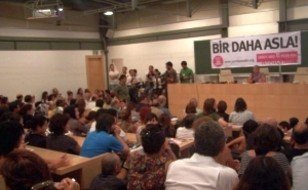



300 people were at Bilgi University to put the makers of the September 12 military coup on trial.
Court of Conscience for the September 12 coup, organized by the Initiative of 70 Million Steps Against Coups, had as its goal to try symbolically the makers of the September 12 Coup, generals Kenan Evren, Sedat Celasun, Nurettin Ersin, Tahsin Şahinkaya and Nejat Tümer, with the participation of those who witnessed the period.
Head of the Court lawyer Fethiye Çetin stated in her opening speech that the September 12 coup was still continuing with its institutions, rules and mentality, affecting every field of life.
She emphasized that to try in our consciences the individuals whose past crimes were already known, it was necessary to face the past and that this could only be done with the active participation of the society.
Orhan Miroğlu, Ragıp Zarakolu, Hacay Yılmaz, Sabahattin Selim Erhan, Atilla Keskin, Bülent Aydın, İhsan Eliaçık and Hüner Buğdaycıoğlu joined the court with their testimonies.
“Choice is ours”
Lawyer Ergin Cinmen, who presented the first indictment, said that the September 12 Coup was the continuation of the March 12 Coup (which had come ten years before it) and it was necessary to understand the social and economic dimensions of the period before September 12.
Global Action Group activist Meltem Oral read the second indictment prepared by writer Ahmet İnsel. This one emphasized that those who made the coup had committed a crime against humanity.
İHD
After the indictments were read, it was time for the testimonies of those who witnessed the period. The first witness was Leman Fırtına, who had a son in prison at the time.
She explained how difficult it was to help their children, how they had to endure much hardship and bad treatment to have their voices heard by those in power and how they finally founded the Human Rights Association (İHD).
Writer Adalet Ağaoğlu said that in order to face the past, it was necessary to put aside the official history.
After her, Salih Zengin, a witness who had actually spent some time in the Diyarbakır prison during this period, talked about what he had to endure:
“I was seventeen when I found myself in prison. I did not know much Turkish. I did not know that there could be a state so cruel to its own citizens until I was in the Diyarbakır Prison…”
“We had to stay in cells filled with human feces, 30-40 people at a time. In winters, they would take us out all naked. They would force us to get on each other naked.”
“All this torture was because of one reason: We were Kurds. Our conscience will stay scarred unless we call to account those responsible for what happened.”(OA/EÜ/TB)

Protesters Demand Trial of Coup Leaders in Front of Parliament
Demanding Trial of Coup Generals
Former Prosecutor: "My Indictment of Coup General is Prepared"
Former Prosecutor Wants Coup General Evren in Court

Coup Leader Evren’s Name to Be Erased from Izmir Schools

Time To Face Diyarbakır Military Prison Of The September 12 Coup

12 September: Human Rights Violations
Protesters Demand Trial of Coup Leaders in Front of Parliament
Demanding Trial of Coup Generals
Former Prosecutor: "My Indictment of Coup General is Prepared"
Former Prosecutor Wants Coup General Evren in Court
Coup Leader Evren’s Name to Be Erased from Izmir Schools
Time To Face Diyarbakır Military Prison Of The September 12 Coup
12 September: Human Rights Violations