Situation of Earthquake Victims in Van still Critical




Halis Yerlikaya from the Turkish Medical Association (TTB) and Çetin Erdolu from the Health and Social Service Workers Union (SES) pointed out that Van was still far away from normal life after two major earthquakes hit the city on 23 October and 9 November 2011.
According to Yerlikaya and Erdolu, only the poorest people are still staying in the city. Therefore, they urged to provide free health service to the earthquake victims as soon as possible.
After the 7.2 magnitude earthquake on 23 October and the 5.7 aftershock on 9 November, people holding a green card (entitling poor families to free medical treatment) or without social security were not required to contribute to the payment of drugs. However, the Social Security Institution (SGK) lifted this regulation on 22 December 2011 claiming that "life in Van came back to normal".
The TTB and SES criticized the discontinuation of the distribution of free drugs in their second monthly report. They emphasized that this service should be started again.
The two institutions applied to the SGK Health Presidency for the continuation of the free drugs distribution in the earthquake region around Van. They have not received any response yet.
"Victimized for a second time"
Yerlikaya, member of the TTB Central Council, stated, "Nothing has changed in Van. Living conditions are still very difficult".
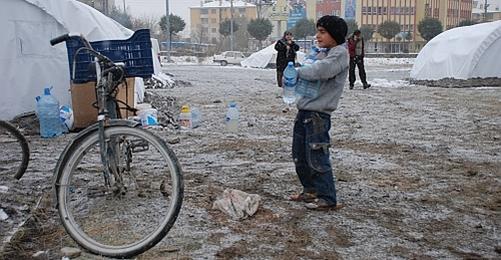
"The ones who are still staying in Van are the poorest people who do not have any other option. A number of people are still living in tents under unhealthy conditions. The government gives the impression as if it was all moonlight and roses and revokes granted rights".
"Especially women, children and elderly people are suffering from health problems. Food borne diseases are common as well as diseases in the lower and upper respiratory system and diseases in the urinary tract due to bad housing conditions. In short, people who are suffering from such health problems are made victims a second time if they have to pay for medication", Yerlikaya explained.
"Existing law does not apply to these conditions"
SES General President Erdolu emphasized that the victimization that prevailed since the earthquakes was still continuing due to housing and access to medical services.
"Constant health service was not provided and health services do no not sufficiently reach districts and villages away from the centre. In addition, the earthquake victims are not being provided with shelter".
Erdolu stressed that existing laws on access to health service could not be applied in Van under the present conditions. He demanded to provide medical services free of charge including drugs and examinations to the earthquake victims as soon as possible regardless of social security.
In 2012, the system of the green card for free medical service is going to change. According to the new regulation, people with an income exceeding the minimum wage by one third will have to pay a premium of between TL 33 and 200 (€ 15-100). It is not clear yet how this new regulation is going to be applied to the earthquakes victims in Van, most of whom are green card holders.
bianet tried to obtain information on this issue from the Disaster and Emergency Management Presidency (AFAD) and was directed to the Ministry of Health which again directed bianet's inquiry to the SGK. The latter institution did not give any further information. (NV/VK)
* Photograph: Yunus Keleş


Galatasaray Üniversitesi Gazetecilik mezunu. İstanbul Üniversitesi'nde Engellilik Araştırmaları Yüksek Lisansı yaptı. 2011-2017 yılları arasında bianet'te muhabir/editör olarak çalıştı. Greenpeace Akdeniz’de İletişim Sorumlusu olarak 4 yıl görev aldı. Şu anda Europe Beyond Coal (Türkiye ve Batı Balkanlar) İletişim Danışmanı.

VAN EARTHQUAKE AFTERMATH
Tent Cities Emptied - Former Tenants Left without Shelter
Teachers Take the Street in Aftermath of Van Earthquakes
EARTHQUAKE AFTERMATH
20,000 Containers Needed for Van to Counter Minus Degrees
VAN EARTHQUAKE
Being a Journalist in the Disaster Zone
Major Earthquake in Eastern Turkey
VAN EARTHQUAKE AFTERMATH
Tent Cities Emptied - Former Tenants Left without Shelter
Teachers Take the Street in Aftermath of Van Earthquakes
EARTHQUAKE AFTERMATH
20,000 Containers Needed for Van to Counter Minus Degrees
VAN EARTHQUAKE
Being a Journalist in the Disaster Zone
Major Earthquake in Eastern Turkey
Engineers Inspect Hasankeyf: Caves Damaged
Sexual, Physical Violence Against People With Disabilities Increase
Villagers on Watch in Çanakkale Against Geothermal Power Plants
Judge Replaced Ahead of Summary Judgement in Soma Trial
Most Miner Families Withdraw Complaint in Occupational Homicide Trial in Şirvan