





Acknowledge Women's "Invisible Labour" on 1 May!

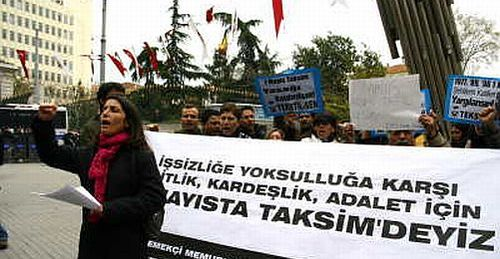



Filiz Karakuş from the Socialist Feminist Collective says, "On 1 May, the male hegemony that is also perpetuated by men from the working class needs to be opposed by the female and male working class."
Necla Akgökçe from the trade union Petrol-İş Women's magazine believes that women need to demand their rights from trade unions in the face of discriminatory practices.
Independent feminist Nilgün Yurdalan has called for an end to the male hegemony within trade unions.
Meanwhile, Yıldız Ay from the Collaborative Daily Wage Women's Union points out that the main issue on Labour Day should be poverty.
Karakuş: Labour Day should make women's labour visible
Whether women have a paid job or not, they all do the housework, as it is seen as a woman's duty.
Anti-capitalist politics needs to start with the assumptions that the male hegemonic system oppresses all women and that men from the working class are also among the oppressors. If we stand against exploitation, we need to focus on the exploitation of women by men. Labour Day should also be a day of making women's labour visible.
Employment and social security policies disregard women's labour at home. Women are sentenced to dependence on husbands and fathers and to housework. The current government produces policies that encourage women to be mothers and good wives. Labour Day should be the day we protest against this.
Akgökçe: Women need to demand rights from unions
The first demand of working women needs to be safe, regular work with social security. Because of the economic crisis many women have lost their jobs and many have even given up hope of finding a new job.
Working women also carry the burden of housework and childcare. It is vital that this burden is taken away from them with the formation of childcare centres at work and new social security policies.
If trade unions see women as members with equal rights, they need to fight against conditions that prevent women from having work or a social life and that make their work at home invisible.
Ay: We demand social security and job safety
Our primary demands are social security and job guarantees. We want legal change so that our labour becomes visible and so that women working on a daily wage basis get worker status. On Labour Day our most pressing problems are the cost of living and poverty. Because we have no job safety and no social security, we face poverty.
Yurdalan: An end to male hegemony in trade unions!
Men, the state, trade unions and society need to accept that housework exists and has market value. It has to be shown that women who work outside of the home and then also do the housework are doubly exploited.
It is vital that equal work brings equal pay, that childcare centres are opened at work places and trade unions, that jobs with trade union membership, social security and guarantee are demanded, and that the principle of the social state is defended against neoliberal politics. The budget that is used for armament, militarism and war needs to be spent on women.
When resistance results in people being given their jobs back, the worker needs to be able to decide whether to accept compensation or return to work. Otherwise, women are paid off and sent home and do not find work again. (BB/AG)


Decent Work for Domestic Workers

Women Working Home-Based Seek their Rights

Peaceful Protests on Labour Day

More than 50 Percent of Women Work off the Record

Municipalities Protect Women with Collective Labour Agreement

EU PROGRESS REPORT
Women's Rights Must be Implemented in Daily Life

Most Female Labour Unregistered
Decent Work for Domestic Workers
Women Working Home-Based Seek their Rights
Peaceful Protests on Labour Day
More than 50 Percent of Women Work off the Record
Municipalities Protect Women with Collective Labour Agreement
EU PROGRESS REPORT
Women's Rights Must be Implemented in Daily Life
Most Female Labour Unregistered