





'General Culture' Course Books: Girls at Home, Boys Out and About

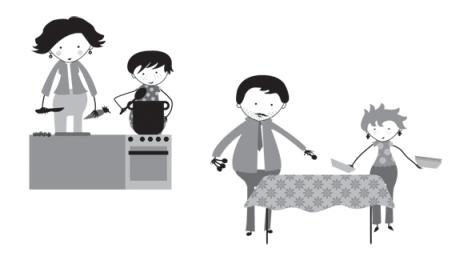



The Education and Science Workers Union (Eğitim Sen) Women's Secretariat criticizes the enforcement of traditional gender roles in the course books for general culture lessons printed in 2009. The subject of 'General culture' is taught from 1st to 3rd grade of Turkish primary schools. The subject is concerned with topics such as national cultural values, family life, respect for life, nature and the environment or basic knowledge about Atatürk and the Turkish state.
In their research Eğitim Sen identified once more the traditional emphasis on the gender based approach of the books and put forward the following requests:
* Women should be shown independent of their role as a mother or a wife.
* Women should be shown more often outside of their homes in public areas.
* Especially for girls encouraging examples of achieving success should be included.
* A wide range of activities should be presented to improve the children's imaginations and to support their development into free individuals.
* The male role model should be depicted more under the aspect of gender equality by showing men less in public places but more in the home environment, contributing in an equal cooperation.
* Social gender education should be compulsory for all teachers.
* Representatives of unions and NGOs should be part of the book review commission.
* Lessons on "Social Gender" should be implemented in the education faculties and be made compulsory.
The research aimed to draw attention to the role models of social gender presented by the visuals of children and adult characters in the 'general culture' books, which were approved by the Ministry of Education for the early years of the children's socialization process. An analysis of the visuals in the books showed that pictures of Atatürk and further small pictures were difficult to spot and put out of context; figures of grandfathers and grandmothers were equated with figures of fathers and mothers.
Pictures of males outnumber pictures of females by far
In this year's books for 1st, 2nd and 3rd grade there are 62 pictures of women and 98 visuals of man. Girls are shown in 165 images, boys are depicted 253 times.
Girls are at home, boys are outside
In terms of locations 54 females are shown at home and 8 in places outside home, for males it is 5 at home and 93 outside home respectively. The number of girls pictured at home is 23, outside home it is 142. For boys 21 illustrations show them at home and 232 outside of home respectively.
The pictures were also analyzed under the aspect of role models:
Women and men are depicted mainly in the traditional perception of gender roles. This means for females: 8 teachers, 12 mothers, 2 customers, 2 business women and 1 doctor. Whereas for males 2 managers, 1 teacher, 18 fathers, 1 poet, 1 doctor and 1 policeman are shown.
Further results revealed by the research:
Visuals of boys outnumber pictures of girls; adult women are mainly shown in their roles of a mother or a wife; concerning professional life women are continuously represented as mothers besides professions like teacher, hospital nurse or medical attendant.
Professional life for men is mainly depicted in pictures of managers and supervisors. At school class representatives and club presidents are usually shown as boys. Girls can be seen playing with threads and dolls while boys are mostly shown playing ball. In a chapter entitled "my dreams" the child who makes up dreams and plans for the future is a boy.
According to the Eğitim Sen analysis the type of family represented in the course books depicts a happy, urban, middle-class nuclear family. (EZÖ/VK)


Dramatic Situation of Secondary Education in Turkey
Education
"Get Rid of Hidden Sexism in School Books"
Students face daily human rights violations in books:
School Books are Turkish, Muslim, Male, Heterosexual and Racist

New School Books for Peace and Equality

Foundation Investigates Human Rights in School Books
Dramatic Situation of Secondary Education in Turkey
Education
"Get Rid of Hidden Sexism in School Books"
Students face daily human rights violations in books:
School Books are Turkish, Muslim, Male, Heterosexual and Racist
New School Books for Peace and Equality
Foundation Investigates Human Rights in School Books
Politician and NGOs Urge for Clarification of Önkol's Death
EU PROGRESS REPORT
Women's Rights Must be Implemented in Daily Life

Protests against Health Care Contribution Rate
Greens Launch Trial for Palovit Valley

"When Will Mohsen Abdolkhani and Hamid Karimnia Be Released?"