Most Female Labour Unregistered

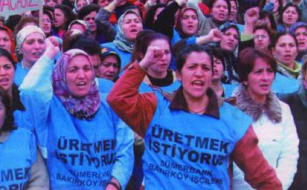



The Iniative for Women’s Labour and Employment (KEİG) has published a report entitled “Women’s labour and employment problems in Turkey and policy suggestions”
According to the report, women still face pressures and inequality at work and at home.
The report predicts that the crisis, which has created millions of unemployed, will increase poverty, and affect women the most.
Economy is sexist
The authors of the report argue that a different approach is needed towards women to combat not only the effects of the crisis, but the essentially sexist nature of the economy.
27 women’s organisation collaborated in creating the report, in which they identified the following basic problems:
Women’s burden increasing in rural areas: Agriculture is an area where many women are employed. According to November 2008 statistics, 45 percent of women’s labour is in agriculture.
Low female employment in cities: In cities, only one in five women over 15 is employed.
High percentage of unregistered labour: According to December 2008 data, 58 percent of female labour is unregistered, while the rate for men is 38 percent.
Gap in wages: In cities, male and female wages differ by an average of 22 percent.
Lack of social security: Housewives and women working without social security are excluded from social security programmes and remain dependent on husbands or fathers. The contribution payments for voluntary payments are so high that most women do not avail themselves of that service.
Male-dominated trade unions: Around 9 percent of employees are in trade unions, numbering 892,000 workers. Women make up only 10 percent of this number and are not represented in trade union managing boards.
The KEİG has called for the following:
- Gender equality needs to be a consideration in development plans.
- Budgets based on gender must be created in order to guarantee equality.
- Employment strategies must be created.
- Discrimination in promotions and at-work training must end.
- Sexual harrassment must be prevented.
- Working conditions must be improved.
- Positive discrimination must be applied.
- Women must participate in trade union decision making processes.
- Conciliatory policies must be applied at work and in private lives.
KEİG has called on State Minister Mehmet Şimşek, Minister of Employment and Social Security Faruk Çelik, Minister for Women and Family Nimet Çubukçu and NGOs to work towards fulfilling these demands. (EZÖ/AG)


WOMEN LABOUR CONFERENCE
The Strong Link between Patriarchy and Capitalism

Acknowledge Women's "Invisible Labour" on 1 May!

Üç Gazeteye Sansürü Güzelbey Değil, "Bürokratı" Düşünmüş...

Women in Tarlabaşı: Life in the Backstreets of Beyoğlu

Discrimination Adds to The Plight of Seasonal Workers

Supreme Court Devalues Housework
Women Insecure at Home, at Work, on Street
Women Lost as Unregistered Economy Grew
WOMEN LABOUR CONFERENCE
The Strong Link between Patriarchy and Capitalism
Acknowledge Women's "Invisible Labour" on 1 May!
Üç Gazeteye Sansürü Güzelbey Değil, "Bürokratı" Düşünmüş...
Women in Tarlabaşı: Life in the Backstreets of Beyoğlu
Discrimination Adds to The Plight of Seasonal Workers
Supreme Court Devalues Housework
Women Insecure at Home, at Work, on Street
Women Lost as Unregistered Economy Grew
Politician and NGOs Urge for Clarification of Önkol's Death
EU PROGRESS REPORT
Women's Rights Must be Implemented in Daily Life

Protests against Health Care Contribution Rate
Greens Launch Trial for Palovit Valley

"When Will Mohsen Abdolkhani and Hamid Karimnia Be Released?"