





Women Needed in Local Politics



“Violence and poverty are such big problems that we often don’t know where to start. What we have to do is to see the relation between the problems in the places where we live and our daily lives and our daily politics.”
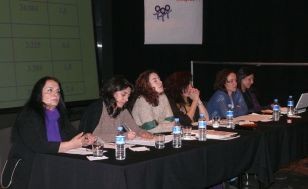
İlknur Üstün, the Ankara branch manager of the Association for the Education and Support of Women Candidates (KA-DER) spoke at a panel on “the basis of local politics” organised by the Amargi Women’s Cooperative.
 She said that women have
started to become empowered in different locations and that “as women, we have
to become part of local politics in order to change existing politics.”
She said that women have
started to become empowered in different locations and that “as women, we have
to become part of local politics in order to change existing politics.”
The panel, organised on Saturday (31 October) at garajistanbul, was also attended by Nükhet Sirman from Bosphorus University, Meriç Eyüboğlu from the Feminist Collective, Belgin Çelik, a candidate for muhtar (neighbourhood official) in Beyoğlu, central Istanbul, and academic Ayten Altan. The panel was moderated by sociologist Pınar Selek.
"Not even the salt in the soup"
Üstün criticised municipalities for opening synthetic football pitches, only serving men, and presenting this as service. She pointed to the fact that 99 percent of municipal council members were male: “Women are not even the salt in the soup at the moment.”
She blames traditional gender roles for the invisibility of women in politics.
Post-coup concept of municipality
The concept of municipal service has also changed since the military coup of 12 September 1980, so Sirman: “12 September emptied politics of meaning and divided people into those giving and those receiving service. Those giving service have been divided into public and private sector. Those who want to rise high under the ruling Justice and Development Party’s (AKP) understanding of service are the men whose wives are sitting at home; those who receive services cannot express their demands.”
Altan emphasised that there were some women in local politics: “They make up 2 percent of the councils, but women create solutions to problems with local collectives.”
If the percentage of women rose to 30 percent, then the country’s agenda would also change, so Altan.
Feminist candidates in Beyoğlu
Eyüboğlu pointed out the importance of women as agents in local politics, saying that local politics concerned women. Explaining that they were aiming for women to internalise feminist politics on a permanent basis, women in Beyoğlu have decided to put forward feminist Ülfet Taylı, an activist at the “Purple Roof” women’s shelter, as a councillor candidate for the local elections. Taylı, too, has said that politics would be a collective effort.
Çelik, as a feminist neighbourhood official candidate, said that she has put herself forward in order to make her neighbourhood in Beyoğlu a more livable place for the oppressed and marginalised. (BÇ/AG)


Campaign for Gender Equality in Politics
Women Have Already Lost Upcoming Local Elections

Again, Moustaches Would Dominate Parliament
Encourage Women For More Active Participation
AKP Disregarded Erdoğan’s Advice on Women’s Quota

Women in Tarlabaşı: Life in the Backstreets of Beyoğlu

Architects Organise Symposium on Local Administration

Women's Quota a Must

Local Elections: “Male-Dominated Parties Will Not Get Our Votes”

Parties Have Used and Then Dropped Women

Campaign for Gender Equality in Politics
Women Have Already Lost Upcoming Local Elections
Again, Moustaches Would Dominate Parliament
Encourage Women For More Active Participation
AKP Disregarded Erdoğan’s Advice on Women’s Quota
Women in Tarlabaşı: Life in the Backstreets of Beyoğlu
Architects Organise Symposium on Local Administration
Women's Quota a Must
Local Elections: “Male-Dominated Parties Will Not Get Our Votes”
Parties Have Used and Then Dropped Women