





Media and Education's Crucial Role in Struggle against Hate Crime

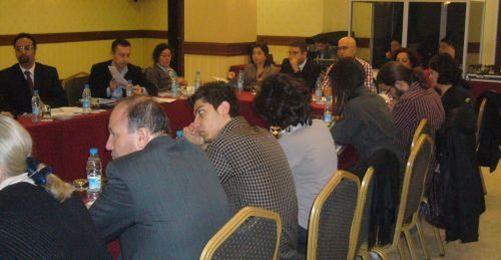



"Hate Speech and Hate Crime" was the topic of a meeting of the Human Rights Agenda Association (İHGD) in Ankara on Saturday (6 November). The association emphasized the need to implement an according awareness in the media and the education system.
Tankut Taşkın Soykan gave a presentation on the struggle against hate speech and hate crime by the Organization for Security and Co-operation in Europe (OSCE) in the beginning of the meeting that was supported by the German Embassy.
Soykan explained that the European Commission against Racism and Intolerance (ECRI) as well as the Office for Democratic Institutions for Human Rights (ODIHR) of the OSCE exist to counter these crimes. Rights advocates and non-governmental organizations can convey information to this structure which is being fed only very little by information from the Turkish officials.
Caution with new media
Prof. Mutlu Binark from Bahçeşehir University (Istanbul) warned that hate speech was regularly widespread in new kinds of media such as blogs, forums, twitter and facebook. He stressed the need to develop an according strategy within the educational system.
Awareness of local media and in education
Ferai Salman, representative of the Joint Platform for Human Rights (İHOP), described the need of raising awareness for hate speech and freedom of expression also on the level of the local media. He said that this area should be monitored on the other hand. It was underlined that local and nation-wide journalist organizations were obliged not raise their voice against this kind of speech as much as they do so against violations against journalists.
Attack against Romans tried under article 216
The President of the Izmir Romani Association, Abdullah Cıstır, drew attention to the importance of the courts to demonstrate determination in the struggle against hate crimes. Referring to the attacks on Romans in Selendi (western Turkey) said that the trial opened under article 216 of the Turkish Criminal Court (TCK) on "inciting hatred and hostility" was the result of their determined following up of the procedures.
EU, Prime Ministry and Ministry of Justice part of the process
The participants of the meeting shared their observations and suggestions. They emphasized the importance of inviting representatives from the General Secretariat of the European Union, the Prime Ministry and the Ministry of Justice. They furthermore agreed on the importance to include other ministries and public institutions into the process.
It was criticized that the Presidency of the General Staff had targeted different sections of society in its past statements. Moreover, the participants requested Prime Minister Erdoğan to refrain from exclusionary statements.
The meeting was attended by representatives of the Human Rights Centre of the Ankara University Political Sciences Faculty, the LGBT associations KAOS GL and Black Pink Triangle (Izmir), KURT DER, the Refugees Association, the Diyarbakır Bar Association, the Civil Society Development Centre (STGM) and the Caucasian Association. (EÖ/VK)


A graduate of the French Language and Literature Department at İstanbul University. He has served as the Turkey representative for the international organization Reporters Without Borders (RSF), where he began as a reporter in 1996. Since 1999, he has worked at bianet, a project of the IPS Communication Foundation, as the coordinator of the Legal Support Desk, editor for freedom of expression, and editor-in-chief. He has authored more than 4,800 signed news articles and opinion pieces. He has also written for Bizim Gazete and the journal Güncel Hukuk. He currently prepares the Media Monitoring Reports at bianet.

INTERNATIONAL CONFERENCE ON HATE CRIMES
Law on Hate Crimes Long Overdue
More than 28 Years in Jail on Hate Murder

Campaign for Hate Crime Law

CONFERENCE ON HATE SPEECH AND HATE CRIMES
Media's Important Role for Hate Crimes
CONFERENCE ON HATE SPEECH AND HATE CRIME
Journalists' Struggle against Discrimination
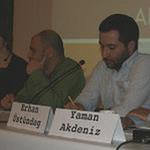
Academics Warn of Hate Speech in Media

INTERNATIONAL CONFERENCE ON HATE CRIMES
Law on Hate Crimes Long Overdue
More than 28 Years in Jail on Hate Murder
Campaign for Hate Crime Law
CONFERENCE ON HATE SPEECH AND HATE CRIMES
Media's Important Role for Hate Crimes
CONFERENCE ON HATE SPEECH AND HATE CRIME
Journalists' Struggle against Discrimination
Academics Warn of Hate Speech in Media
MAY 3 WORLD PRESS FREEDOM DAY
Journalism rights thrive on reader support!
BİA MEDIA MONITORING REPORT 2025
Those who want to silence journalists are now more brazen!
BİA MEDIA MONITORING OCTOBER-NOVEMBER-DECEMBER 2025
The future of journalism is in danger under government pressure!
BİA MEDIA MONITORING JULY-AUGUST-SEPTEMBER 2025
Prolonged detentions and judicial control tighten pressure on journalists
BİA MEDIA MONITORING APRIL-MAY-JUNE 2025
Unprecedented pressure on journalists under the government's watch