Journalist Attacked after Report about Attacks on Kurds
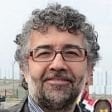
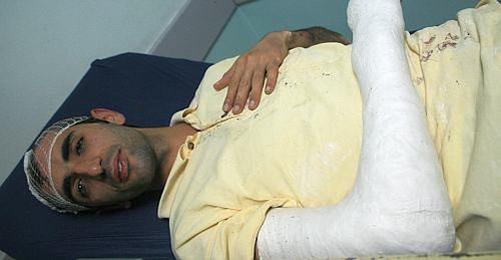



In the evening of 25 May, Dicle News Agency (DİHA) reporter Ömer Çelik was assaulted in the Istanbul district of Şişli by a group of people. The attackers called themselves üklücü ('idealists') in reference to the "Grey Wolves", an ultra-nationalist and neo fascist youth organization of the Nationalist Movement Party (MHP).
Çelik, student at the Marmara University Faculty of Communication, was brought to the emergency room of the Etfal Hospital after the incident. He underwent medical treatment in the brain surgeon ward and the orthopaedic ward. Çelik has got two cracks in his skull and his left arm is broken in three places below the elbow. He was given stitches to his head. His arm has been encased in plaster.
The journalist had recently reported about escalating violence against Kurdish students in several cities. Çelik was discharged from hospital the following morning. However, the risk of a trauma was imminent for 24 hours.
Attackers got Çelik's camera
The DİHA Agency announced that Çelik got on the bus from Beşiktaş to Şişli (European side of Istanbul) at around 9.30 pm on Tuesday night (25 May). The journalist was followed by three people whom he knew from Marmara University and who introduced themselves as ülkücü. According to DİHA, a group of eight people, alleged members of the so-called Hearth of the Ideal (Ülkü Ocakları), an organization affiliated to the Grey Wolves, assaulted Çelik at a bus stop in Şişli after he had got off the bus.
As reported by DİHA on 26 May, the attackers were recorded by security cameras how they approached the journalist with clubs in their hand.
According to the footage, the aggressors waved with their hands and arms when they left the scene after the attack. It was stated that two attackers were visible; one of them wore a black t-shirt and obviously held a club. Journalist Çelik went to the police yesterday (26 May) in order to identify the attackers.
Incapable of working for 1 month
The police took Çelik's statement in hospital. Çelik said that the people he knew from university got on the same bus. He was attacked after he had gotten off the bus at a Şişli bus stop. The student stated that he was able to identify the attackers and filed a criminal complaint.
The journalist's medical report determined that Çelik will be incapable of working for one month. He must be kept under constant observation.
Çelik had published an interview with academic Özgür Sevgi Göral one day prior to the attack (24 May). He drew attention to the "increasing racist attacks" against Kurdish students in eastern provinces. The journalist wrote that these attacks had reached alarming dimensions.
Altunöz threatened, Ural attacked
On 19 May, private security officials interfered when DİHA reporter Murat Altunöz covered a boycott organized by the Mustafa Kemal University Students Association (MKÖDER) in the university's canteen. Altunöz was threatened by the university's securtiy staff and by civilians personating themselves as gendarmerie officers.
Altunöz was forced to enter a car and was threatened, "We warned you before. Why are you making news for DİHA? You will have to face bad things". Afterwards, the people in the car let him go.
Yet another DİHA reporter, Pınar Ural, announced to have been assaulted in a contracted public bus of the Istanbul Metropolitan Municipality after she had covered a students' action on the Maslak Campus of the Istanbul Technical University (İTÜ) on 17 May. (EÖ/VK)


A graduate of the French Language and Literature Department at İstanbul University. He has served as the Turkey representative for the international organization Reporters Without Borders (RSF), where he began as a reporter in 1996. Since 1999, he has worked at bianet, a project of the IPS Communication Foundation, as the coordinator of the Legal Support Desk, editor for freedom of expression, and editor-in-chief. He has authored more than 4,800 signed news articles and opinion pieces. He has also written for Bizim Gazete and the journal Güncel Hukuk. He currently prepares the Media Monitoring Reports at bianet.

2 DİHA Reporters Threatened in 1 Week
"Attack on Journalist Gökkaya is Attack on Social Peace"
SAĞLIK BAKANI İÇİN SORU ÖNERGESİ
Niye Talimat Değil, Ambulans Geldi?

3 Journalists Attacked in 2 BDP Demonstrations

DHA Reporter Cevdet Şen Attacked in Izmir
Aktivistlerden Reha Erdem'e Çağrı: İsrail'i Boykota Katılın, Ödülü Geri Verin
DİHA Reporter Detained, Demonstrator Severely Injured
TURKISH JOURNALISTS ASSOCIATION INDIGNANT
Two Female Journalists Attacked
Journalist Yılmaz Attacked Twice in Three Months
Kurdish Media Condemns Attacks and Oppression
2 DİHA Reporters Threatened in 1 Week
"Attack on Journalist Gökkaya is Attack on Social Peace"
SAĞLIK BAKANI İÇİN SORU ÖNERGESİ
Niye Talimat Değil, Ambulans Geldi?
3 Journalists Attacked in 2 BDP Demonstrations
DHA Reporter Cevdet Şen Attacked in Izmir
Aktivistlerden Reha Erdem'e Çağrı: İsrail'i Boykota Katılın, Ödülü Geri Verin
DİHA Reporter Detained, Demonstrator Severely Injured
TURKISH JOURNALISTS ASSOCIATION INDIGNANT
Two Female Journalists Attacked
Journalist Yılmaz Attacked Twice in Three Months
Kurdish Media Condemns Attacks and Oppression
MAY 3 WORLD PRESS FREEDOM DAY
Journalism rights thrive on reader support!
BİA MEDIA MONITORING REPORT 2025
Those who want to silence journalists are now more brazen!
BİA MEDIA MONITORING OCTOBER-NOVEMBER-DECEMBER 2025
The future of journalism is in danger under government pressure!
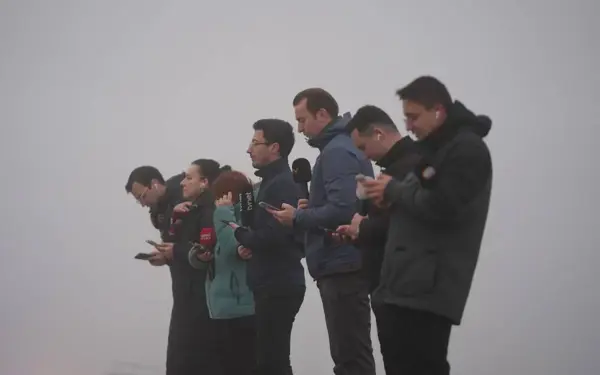
BİA MEDIA MONITORING JULY-AUGUST-SEPTEMBER 2025
Prolonged detentions and judicial control tighten pressure on journalists
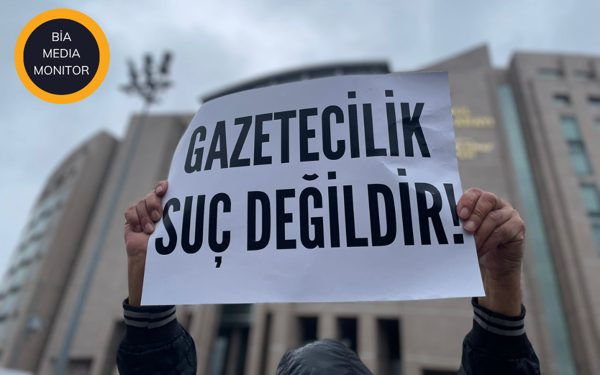
BİA MEDIA MONITORING APRIL-MAY-JUNE 2025
Unprecedented pressure on journalists under the government's watch