





“Prime Minister Should Apply Message of Tolerance at Home”



Monday (6 April) was the 13th time that the Day of Killed Journalists in Turkey was commemorated.
 Journalists
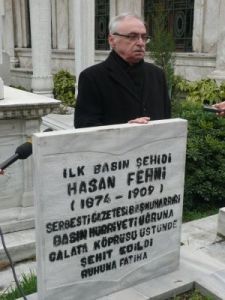
met at the grave of Turkey’s first victim, Hasan Fehmi, the editor of the
Serbesti newspaper who was killed in 1909, 100 years ago.
Journalists
met at the grave of Turkey’s first victim, Hasan Fehmi, the editor of the
Serbesti newspaper who was killed in 1909, 100 years ago.
Tolerance rather than boycotts
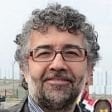
Orhan Erinç, president of the Journalists’ Society of Turkey (TGC) said that 62 journalists had been killed in Turkey. Without addressing him explicitly, Erinç callled on Prime Minister Recep Tayyip Erdoğan to extend the message of tolerance sent to the world with the “Alliance of Civilisations” summit in Istanbul to the press.
“We expect the facilities for journalists to be developed, and we expect tolerance instead of boycott calls when journalists publish news that does not suit someone.”
“Even if politicians do not agree, journalism is one of the most difficult professions in the world. People do not realise the tension and stress, as well as the violence journalists can face. Then there are others, like İsmail Güneş (who died in a recent helicopter crash when covering the pre-election period) who die in work-related accidents.”
"The murderers are never caught"
Nükhet İpekçi, the daughter of murdered journalist Abdi İpekçi, spoke to bianet about whether recent claims of Ergenekon involvement in her father’s death have raised hopes about bringing the perpetrators to justice:
“We have been exhausted with hoping and hoping. Let us start with finding out why Hasan Fehmi’s murderers were not punished. Whose murderers were brought to justice?”
 Erinç, TGC representatives Turgay Olcayto,
Zafer Atay, Gülseren Güver, Sibel Güneş, TGC press senate president Necmi
Tanyolaç, vice president Seraceddin Zıddıoğlu, Turgut Genç and Engin
Köklüçıkar, president and general secretary of the Foundation for Social
Support of Journalists respectively, writer Emin Karaca, Nükhet İpekçi and many
others first gathered at Hasan Fehmi’s grave in Çemberlitaş and then visited an
exhibition of killed journalists in the TGC Press Museum.
Erinç, TGC representatives Turgay Olcayto,
Zafer Atay, Gülseren Güver, Sibel Güneş, TGC press senate president Necmi
Tanyolaç, vice president Seraceddin Zıddıoğlu, Turgut Genç and Engin
Köklüçıkar, president and general secretary of the Foundation for Social
Support of Journalists respectively, writer Emin Karaca, Nükhet İpekçi and many
others first gathered at Hasan Fehmi’s grave in Çemberlitaş and then visited an
exhibition of killed journalists in the TGC Press Museum.
Turkey does not keep promises
Erinç pointed out that Turkey was a signatory to the European Convention of Human Rights, and that the EU’s Council of Ministers were working on widening the scope of Article 10 of the Convention, dealing with the freedom of expression.
Although Turkey has signed the convention, so erinç, it does not fulfil the criteria.
Journalists still face violence and danger
On 6 April 1909, Hasan Fehmi was shot dead on Galata Bridge in Istanbul. He is known as the first journalist to be killed. Since his death a further 61 journalists have been killed. Since the death of Abdi İpekçi on 1 February 1979, 47 journalists have been killed. 14 of them died in 1992 alone.
Erinç added, “We hope that this period has ended with the murder of Hrant Dink two years ago. However, we know that our colleagues are still threatened, and that they are still exposed to the violence of security forces.” (EÖ/AG)


A graduate of the French Language and Literature Department at İstanbul University. He has served as the Turkey representative for the international organization Reporters Without Borders (RSF), where he began as a reporter in 1996. Since 1999, he has worked at bianet, a project of the IPS Communication Foundation, as the coordinator of the Legal Support Desk, editor for freedom of expression, and editor-in-chief. He has authored more than 4,800 signed news articles and opinion pieces. He has also written for Bizim Gazete and the journal Güncel Hukuk. He currently prepares the Media Monitoring Reports at bianet.

BIA Media Monitoring Report
435 “Though Crimes” in Turkey in 2008

IPI Urges EU Leaders to Prioritise Press Freedom in Membership Talks with Turkey

“Turkey Not Abiding by ECHR Decrees”

Prime Ministry’s Accreditation Ban Continues To Receive Reactions
From the Classroom to the News Room
"Journalism is a Peace Profession"
Bianet: Independent, Alternative Journalism
Journalism Challenges to Turkey
BIA Media Monitoring Report
435 “Though Crimes” in Turkey in 2008
IPI Urges EU Leaders to Prioritise Press Freedom in Membership Talks with Turkey
“Turkey Not Abiding by ECHR Decrees”
Prime Ministry’s Accreditation Ban Continues To Receive Reactions
From the Classroom to the News Room
"Journalism is a Peace Profession"
Bianet: Independent, Alternative Journalism
Journalism Challenges to Turkey
MAY 3 WORLD PRESS FREEDOM DAY
Journalism rights thrive on reader support!

BİA MEDIA MONITORING REPORT 2025
Those who want to silence journalists are now more brazen!

BİA MEDIA MONITORING OCTOBER-NOVEMBER-DECEMBER 2025
The future of journalism is in danger under government pressure!
BİA MEDIA MONITORING JULY-AUGUST-SEPTEMBER 2025
Prolonged detentions and judicial control tighten pressure on journalists
BİA MEDIA MONITORING APRIL-MAY-JUNE 2025
Unprecedented pressure on journalists under the government's watch