Human Rights Watch Leaves The Meeting With The Human Rights Minister Unsatisfied

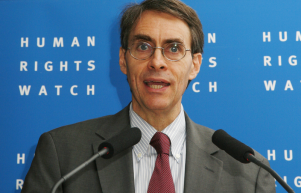



Kenneth Roth, administrator of the Human Rights Watch (HRW), described Cemil Çiçek, minister in charge of the issues related to human rights, with whom he met about their reports about the police violence in Turkey and not punishing those responsible for it, as sarcastic and too defensive.
Roth met with three ministers about the report: Cemil Çiçek, State Minister in charge of the issues related to human rights, Beşir Atalay, Minister of Interior, Mehmet Ali Şahin, Minister of Justice.
“Çiçek denies even the existence of the problem”
According to Roth, Çiçek denies even the existence of the problem and when reminded of the police violence cases, describes this as an outcome of the psychology of the police officer up against terrorism.
“He offered excuses about everything”
Emphasizing that Çiçek offered excuses about every matter they brought up in regards to the human rights violations, Roth said, “When we mentioned the Constitutional Reform, the freedom of expression and the police violence he brought up the constitutional process in the European Union (EU), the EU’s attitude towards Turkey and the violence used by the Kurdistan Workers Party (PKK), respectively.”
“It is ironic that Çiçek is the minister in charge of the human rights. It made me think that if Çiçek was a minister for improving the human rights or one for violating them. Let alone the implementation of the recommendations in the report, he did not even want to discuss the matter.
“It is obvious that the government is divided”
Roth said Atalay, Interior of Minister, was more constructive, more open to the problem, willing to look for a solution, in agreement with the recommendations and said they were trying to implement some of them.
Roth added that Atalay was especially in agreement with keeping the police officers and the units accused of violations out of the investigations about them, stopping the counter suits by the police against the victims and discontinuing with the practice of making statements to protect the suspected police officers. However, he also said that the main problem was if Atalay had the power to implement these changes or would be prevented by people like Çiçek.
“We know that the problem of Iraq, the PKK, the closure case against the Justice and Development Party (AKP) and the EU’s changing attitude towards Turkey have been affecting the reform process negatively. But these reforms should not be done for someone else, but the people of Turkey. It is obvious that the government is divided. The real question is if Erdoğan’s government is loyal to the reforms in spite of all the negative factors.”
“The problem is not only the implementation”
Roth noted that Minister Şahin also agreed that the problem was not with the law about the police violence, but its implementation; however, especially the arrangement regarding using deadly force is open to all kinds of violations.
Roth also pointed out to the disappointment they had with Şahin’s giving permission to 58 article 301 investigations since May, saying it was problematic that the minister sees criticizing the government as a call to violence sometimes and as an insult some other times.
Roth added that the HRW was going to continue watching and reporting the police violence. (TK/TB)

PM Erdoğan Receives Human Rights Award from Libya

Students Refused Deputy Prime Minister to Talk on Human Rights

New Magazine: "Dialogue" for Human Rights

Counter Investigations Against Convicts Filing Complaints Get Reaction
Turkish Activists In Solidarity With The Greek Activists

Protection Of The Violent Police Officers Continue

HRW Report: Human Rights Trend is “Retrograde”

Report on Human Rights Day:
Turkey's Human Rights Situation "Discouraging"

PM Erdoğan Receives Human Rights Award from Libya
Students Refused Deputy Prime Minister to Talk on Human Rights
New Magazine: "Dialogue" for Human Rights
Counter Investigations Against Convicts Filing Complaints Get Reaction
Turkish Activists In Solidarity With The Greek Activists
Protection Of The Violent Police Officers Continue
HRW Report: Human Rights Trend is “Retrograde”
Report on Human Rights Day:
Turkey's Human Rights Situation "Discouraging"
KURDISH QUESTION
PKK Ceasefire to be Terminated on 31 October?
KCK CASE
Court Dismissed Request for Defence in Kurdish

7th Istanbul Gathering for Freedom of Thought

CONSTITUTIONAL AMENDMENTS
58 Percent Said "Yes" to Constitutional Reform Package
Rights Organizations 3 Years ahead of Foreign Minister