Antalya Journalists Discuss Regional Journalism




The Journalism Workshop organised by the IPS Communications Foundation and Press Now in Antalya brought together local reporters from Antalya and Burdur in the south of Turkey.
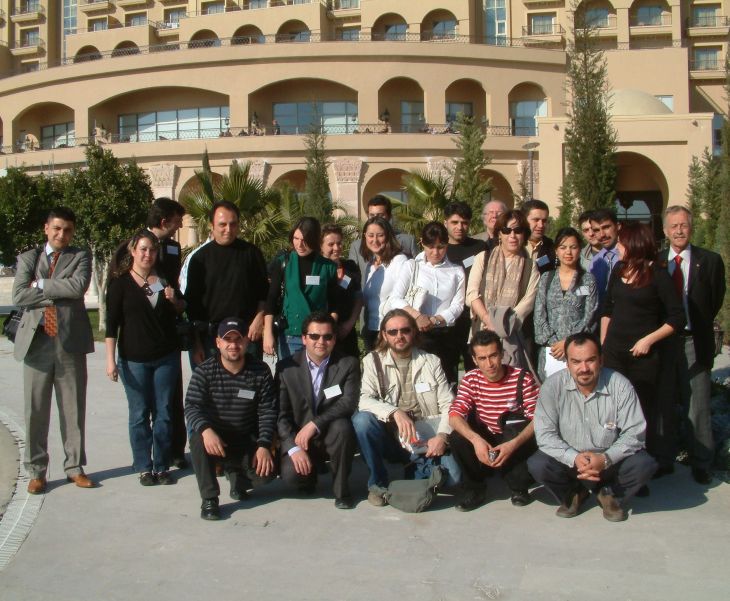 The workshop which took place at the weekend (1 and 2 March) was held by Assistant Prof. Esra Arsan from Bilgi University, Press Now representative Nico Haasbroek and photographer Yücel Tuna, a co-founder of the Photography Foundation.
The workshop was also joined by Press Now Turkey Project Leader Ruken Baris and IPS Communications Foundation Project Consultant Nadire Mater.
Baris and Mater held opening speeches; Mater expressed her disappointment at the low number of female participants.
Lack of training
Mevlüt Yeni, president of the Antalya Journalists’ Society, said that the greatest difficulty local and regional journalists faced was a lack of training.
Gürsu Kunt, the Antalya branch president of the Contemporary Journalists’ Association (CGD) said, “We don’t need journalists, we need journalists with awareness.”
Problems in relations with "VIPs"
Arsan emphasised that the need to earn money must not compromise the stance of the journalist. She also pointed out that local newspapers often had a hierarchy of priorities, starting with MPs and going down to local authorities: “Not everything these people say or do is newsworthy.”
The local journalists said that financial worries often influenced their relations. In a small place, elected and appointed people and business people often did not respond to criticism well and applied sanctions, such as withdrawing advertisement.
Making more out of stories
Mostly, so the local journalists, they used the Internet as a source of information. However, Arsan advised them to support routine news items with other sources in order to make it a special news item.
Haasbroek listened to the questions of the participants. For him, local journalists needed to apply their creativity in order to attract readers.
He argued that the lack of educated staff could be, in part, overcome with new technology.
Photos make a story readable
Tunca introduced photos as items which completed a news item and made it more readable. He said it was important to represent natural movements of people in photographs. He also criticised the fact that the “local VIPs” were photographed most often.
On the other hand, the local journalists said that if certain people were not depicted in the newspaper, this was often misinterpreted.
Participants
Doğan Sönmez (Venüs Radio), Türkan Demir (ART), Kübra Duman (Yeni Alanya Newspaper), Mehmet Yılmaz (Manavgatın Sesi Newspaper), Mevlüt Yeni (President of the Journalists’ Society), Avni Gelendost (Akdeniz Haber Newspaper), Gürsu Kunt (Contemporary Journalists’ Association), Serkan Şimşek (Burdur Radio), Fetih Şimşek (Burdur Radio), Tezcan Özkan (Burdur TV), Duray Çitekçi (Ses 15), Dilek Bakırkaynak (Burdurlunun Sesi Newspaper), Niyazi Manış (Burdurun Sesi Newspaper), Mehmet Tutum (Hedef Newspaper), İbrahim Nanecioğlu (Bucak Gündem Newspaper), Murat Ünlü (Şarkikaraağaç Ekspres Newspaper), Kürşat Tuncel (Yeni Gün Newspaper), Mehmet Gündoğan (Oğuzeli Newspaper), Salih Tutum (Göl Hisar Gündem), İbrahim Erbay (Bölge Gündem), Halil Sımsığı (Burdur Newspaper), Seyhan Kurtman (Antalya Anadolu Agency) (KM/GG/AG)

Independent Media Forum Starts
IPS Communications Foundation and Press Now Organised Workshop in Antalya
BİA² Freedom of Expression Workshop
BİA² Womens Journalism Training in Ordu
Local Media Meet for Future Training Seminars
IPS and Press Now in Giresun
Izmir Seminer on Reporting on Womens Issues
Usak Hosts Children Rights Reporting Seminar
IPS Training for Young Journalists
"From the Classroom to the News Room"
BİA² Local Media Training Program in Trabzon
Independent Media Forum Starts
IPS Communications Foundation and Press Now Organised Workshop in Antalya
BİA² Freedom of Expression Workshop
BİA² Womens Journalism Training in Ordu
Local Media Meet for Future Training Seminars
IPS and Press Now in Giresun
Izmir Seminer on Reporting on Womens Issues
Usak Hosts Children Rights Reporting Seminar
IPS Training for Young Journalists
"From the Classroom to the News Room"