Turkey Commemorates Journalist Mumcu, Killed 15 Years Ago
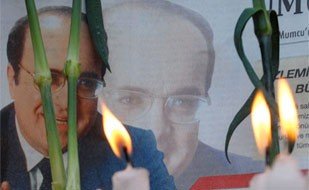



On 24 January 1993, Ugur Mumcu, the investigative journalist, who had brought scores of corruption cases and mafia-politics links into daylight, died when he started the engine of his car, which then exploded in front of his house in Ankara, fragmenting his body to pieces.
On Thursday (24 January), he was commemorated at his graveside in Ankara.
A spate of killings
Mumcu was not the only person to be killed at the time; three academics, of the same political inclination, staunch secularists, were also murdered: Prof. Dr. Muammer Aksoy, Assistant Prof. Dr. Bahriye Ücok and Prof. Dr. Ahmet Taner Kislali.
The four murders are all being investigated in the case dubbed as “Hope”. The trial of one suspect is going on for eight years.
On 14 May 2000, a Necdet Yüksel was detained in Ankara on suspicion of having committed the murder of Kislali on 21 October 1999. He showed the police hidden explosives, guns and ammunition.
Initially death penalty demanded for nine suspects
Prosecutor Hamza Keles of the State Security Court which was carrying out the investigation into the Mumcu murder opened a trial against 17 defendants; for nine of them the death penalty was demanded.
On 14 August 2000, a trial began at the Ankara 2nd State Security Court. On trial were, among others, Ferhan Özmen, Necdet Yüksel and Rüstü Aytufan, accused of placing the bomb in Mumcu’s car.
The case was then transferred to the Ankara 11th Heavy Penal Court after the Supreme Court of Appeals twice overturned rulings. The defense was given time to prepare.
Only one defendant still in custody
Prosecutor Salim Demirci repeated his previous deliberations. An Ekrem Baytap was accused of “attempting to change the constitution by force” and a life sentence was demanded. Mehmet Ali Tekin and Hasan Kilic were accused of “leadership including special duties in an armed terrorist organisation” and the prosecution asked for 18 years and 9 months imprisonment each. Four other defendants, Abdulhamit Celik, Fatih Aydin, Yusuf Karakus and Mehmet Aydin stood accused of “membership in an armed terrorist organisation”, with 12 years and 6 months imprisonment demanded for each.
Although the prosecutor opposed the application of the Resocialisation Law, many defendants were released from detention under that law. Now the only suspect remaining in custody is Ferhan Özmen.
Who was Ugur Mumcu?
Born in 1942, Mumcu worked as a columnist, investigative journalist and writer. He published books on current and historical political issues of Turkey. At the time of his assassination, he was working on research into the Kurdish problem and the PKK.
Ugur Mumcu is survived by his wife Güldal Mumcu, who entered parliament in 2007. Güldal Mumcu and her children established the Ugur Mumcu
Investigative Journalism Foundation (um:ag) in October 1994. (EÖ/TK/AG)
*Biographical information taken from Wikipedia.


A graduate of the French Language and Literature Department at İstanbul University. He has served as the Turkey representative for the international organization Reporters Without Borders (RSF), where he began as a reporter in 1996. Since 1999, he has worked at bianet, a project of the IPS Communication Foundation, as the coordinator of the Legal Support Desk, editor for freedom of expression, and editor-in-chief. He has authored more than 4,800 signed news articles and opinion pieces. He has also written for Bizim Gazete and the journal Güncel Hukuk. He currently prepares the Media Monitoring Reports at bianet.

MAY 3 WORLD PRESS FREEDOM DAY
Journalism rights thrive on reader support!

BİA MEDIA MONITORING REPORT 2025
Those who want to silence journalists are now more brazen!

BİA MEDIA MONITORING OCTOBER-NOVEMBER-DECEMBER 2025
The future of journalism is in danger under government pressure!
BİA MEDIA MONITORING JULY-AUGUST-SEPTEMBER 2025
Prolonged detentions and judicial control tighten pressure on journalists
BİA MEDIA MONITORING APRIL-MAY-JUNE 2025
Unprecedented pressure on journalists under the government's watch