









So, Prime Minister, What is the "Comprehensive Plan"?
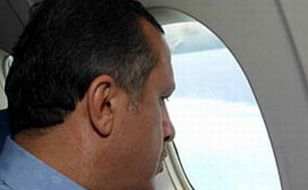



US Foreign Secretary Condoleezza Rice has said that the Turkish government has a "comprehensive plan" to deal with the Kurdish question. However, no one has been told what this plan entails.
Questions for Erdogan
Prime Minister Recep Tayyip Erdogan, on his return from Azerbaijan, said, "They are either going to keep on doing what they do now, or they are going to lay down arms, choose the cities over the mountains and continue the race on the political platform". Now, bianet would like to know:- What is the comprehensive plan?
- Why has it not been announced?
- What steps are planned for peace?
- How are those who collect information are going to be integrated in this process?
- How far will the peace programme of the Peace Parliament be considered?
- What was discussed at the meeting of governors and police authorities of the eastern and southeastern provinces at the weekend? What decisions were made?
In recent days, Erdogan has displayed reluctance to commit to cross-border operations. He has also reacted negatively to the Nationalist Movement Party's (MHP) demand to lift the immunity of MPs from the pro-Kurdish Democratic Society Party (DTP).
At the AKP parliamentary group meeting of 13 November, he said: "Let us be aware that our real power is domestic social peace and solidarity. (...) Turkey is going to solve this problem by preserving brotherhood, increasing freedoms and welfare and establishing justice. (...) We must not forget that the real solution of the problem lies in developing the nation's freedom and welfare even further, and by letting law and justice rule, and we must not give into the logic of terrorism. (...) Democracy and law do not weaken but strengthen us in our struggle against terrorism. All thoughts and demands which are not based on violence, which do not try to gain strength through violece, which do not incite to violence are valuable for us and deserve consideration. This is what politics is really about. Talking and condemning violence, solving problems in dialogue and using laws, this is our understanding of politics. However, those who do not distance themselves from violence, who are not reconciled with law, democracy and the nation's values, continue to look for help from circles outside of politics."
Erdogan happy with Lausanne definition of minorities
"In our country, it is clear who the minorities are. They were defined in the Lausanne treaty. Apart from that there are no minorities in Turkey. (...) On our recent trips abroad [...] they talk about 'the minorities in your country'. When we ask who they are, I am told that my citizens of Kurdish origin are referred to. Because the separatist terrorist organisation describes my citizens of Kurdish origin as 'minorities' abroad. I told them: 'Do not let the citizens of Kurdish origin in my country hear this...They would be the first to rebel against this term.' Because they are the real elements of our country. You are trying to define the real elements as a minority."
On 14 November, on the way to the Czech Republic, he said: "We are not considering any cross-border operations. And our attitude to these operations is that as a priority the arms must be put down here."
On 17 November, returning from Azerbaijan, he said: "Everyone who is against terrorism must not support arms. They are either going to keep on doing what they do now, or they are going to lay down arms, choose the cities over the mountains and continue the race on the political platform. Choosing the path of democratic struggel means not having a gun in the hand or keeping the company of those carrying out armed activities." (TK/NZ/AG)
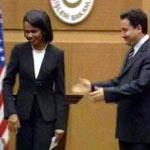
Rice and Babacan: PKK is "Common Enemy"
"Don't touch DTP, Allow PKK to Disarm"
Military Operations Provoke Violence and Do Not Solve Kurdish Issue
Another Operation in Northern Iraq
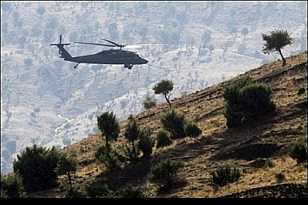
IHD and TIHV: Do Not Close DTP
Baykal Calls for "Neighbourly Relations" with Iraq

First Cross-Border Operation Since Bill
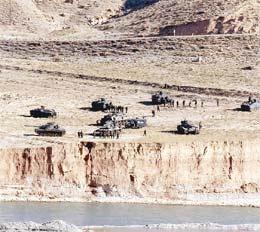
"Erdogan Against Operations But Not For Peace"
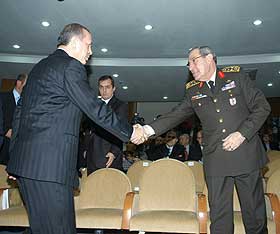
Oh Turks...Love, Protect and Trust Your Kurds!
MHP: DTP Immunity Should Be Lifted
Rice and Babacan: PKK is "Common Enemy"
"Don't touch DTP, Allow PKK to Disarm"
Military Operations Provoke Violence and Do Not Solve Kurdish Issue
Another Operation in Northern Iraq
IHD and TIHV: Do Not Close DTP
Baykal Calls for "Neighbourly Relations" with Iraq
First Cross-Border Operation Since Bill
"Erdogan Against Operations But Not For Peace"
Oh Turks...Love, Protect and Trust Your Kurds!
MHP: DTP Immunity Should Be Lifted